First submission
GC1
You have explained the requirements of working to a brief in detail and with some relevant and specific examples. You have a few typos at the start and are missing your reference list (or links throughout). You have defined terms accurately and have written clearly and coherently. .
GC2
You have managed to plan a response to a brief independently, which demonstrates imagination and creativity. You have researched the client thoroughly and have a good understanding of the target audience and your pre-production documentation for the visuals is detailed and correct.
GC3
You have applied a response to a specified brief to near professional standards (in-focus, correctly exposed, smooth from correct frame rate) and you’ve shown creativity and flair in your idea. You worked completely independently throughout all stages of productions and to professional expectations. This esting would be appropriate for Channel 4 and for the specified audience.
GC4
You have explained your own work on completion of a specified brief and you’ve referenced your own work and research with correct use of subject terminology. You have discussed constraints relating to deadlines but not so much relating to the brief.
Resubmission
GC1
You have comprehensively explained the requirements of working to a brief and you have managed to link to both your own experiences and industry practice and examples throughout.
GC2
You have planned a response to a specified brief that takes into account thorough and in-depth research into the client and the targeted audience. You have conceptualised an idea that is fit for purpose and that would appeal to the target audience. You worked independently and to professional expectations.
GC4
You have critically evaluated your own work and audiences responses on completion of working to a brief. You have demonstrated the collection of feedback and analysed it thoroughly.
Brief
A brief is an outline for a project set by a client. It will specify key points about the project and any features the client wants the finished product to have as well as any requirements such as deadlines. Businesses will often approach media production companies with briefs for media texts they want created, and the media company will use the brief as a go to when creating the product. Commissioning is just this, the company wanting the product created will directly choose the specific company they want to create the product, give them a brief which will let the media company know their specific requirements and targets and then pay the company for the work. This will mean the media company will have been commissioned to produce the product in question. For example the BBC may offer to commission a short film. I could then send them a brief containing all relative details such as the budget, deadlines and audience. So basically you or a client send a proposal type document to the production company and they will decide whether to commission the idea or not. Here is a real life example:
Above is a list of documentaries Channel 4 is interested in commissioning and certain requirements needed for a legitimate response. An example of such a programme would be the highly successful Goggle box. This is a weekly TV programme that shows ordinary people viewing Televisions most popular shows.
The text above shows us who had the final say on whether to commission Goggle box and the comments of the producers.
This however isn't the only way in which jobs are given and carried out. Often a company wanting a media text created will create a tender brief. This basically means the brief is open and that several different production companies can approach the client and propose their own ideas about the project in regards to how they will produce it, how much time it will take, and most importantly how much they will charge. It is then down to the client to choose whoever best suits their needs, although in most cases this will probably be who ever can produce the product to the standard required at the cheapest rate. Company MOFILMS is a leader in people powered marketing connecting with brands all over the world. They work by reaching out to creative individuals of all ages proposing briefs from companies all over the globe. MOFILMS has featured work at the Oscars, the superbowl and even in Times Square. Below are some of the brands MOFILMS have featured.
The full brief can be seen on the website however this is the introduction to it. The brief is targeted at those who live inside Texas and the idea is to create a video showing off Texas. Visa are sponsoring the product and trying to get the pubic of Texas involved.
Alternatively briefs can be responded to in the form of competitions such as our stop motion e-sting that we recently created. Companies such as channel 4 often set competition briefs online that most people can enter. There may be a prize involved such as money or having their work featured publicly. This sort of brief will be responded to by more of an amateur crowd as it gives them the opportunity to develop their skills and build a portfolio.
Reading a brief.
Often briefs will contain some level of flexibility in how they are carried out, however they also contain strict requirements that must be followed. For our e-sting competition brief they were as follows.
As seen here we have strict specified details that must be adhered to, the first of which states to submit your e-sting it must be posted on a blog and the blog address must be sent to E4. This is important as it specifies the way in which the client wants to receive the product and, if not received in this way, the e-sting wouldn't be accepted in the competition. It also suggests to us that we carry out research into the channel to find out who actually watches, this is important so the product you create appeals to the target audience. We see also that we cannot exceed the ten second limit, this is a strict and important requirement and if not followed the sting also wouldn't be taken for consideration. We also learn here that we are able to produce up to three e-stings implying that we aren't allowed to exceed this limit. Lastly we are told that we must incorporate the E4 logo, a specification from the client that must be obeyed. Briefs will often have many different specifications that will alter depending on what the project is.
Negotiating a brief.
We did however have some freedom when choosing what to create for our e-sting in regards to the narrative, just as long as it was a stop motion animation, this wasn't specified by E4 but was by our teacher as it was also an opportunity to complete an animation assignment. After hypothesising our ideas, creating our story boards and shot lists, we took our idea to our tutor for feedback. Our idea didn't require any amendments as it fulfilled all criteria.
Within the professional media industry the level in which a person can bring their own interpretation of a brief largely depends on who the client is and what sort of reputation you have as a professional. For example a top end film studio like Paramount may have a very set idea on how they want a product to be produced and therefore there may not be many ways in which as an individual you can bring your own changes in to a project. An example of this occurring happened recently in regards to the proposed director of the "Wonder Woman" film decided to withdraw from the project due to, "creative differences, Warner Bros. and Michelle MacLaren have decided not to move forward with plans to develop and direct ‘Wonder Woman’ together,” the studio said in a statement." However there are examples in which directors are given full discretion to produce pretty much whatever they want. This was the case when Quentin Tarantino made Pulp Fiction (1994). After his previous titles attaining massive profits he was given pretty much a free pass to create what ever he wanted from the Weinstein company/Miramax as long as it was in the same vein, that being a crime film. He states this in an interview that can be seen here.
When responding to a brief there are certain legal and ethical constraints that may apply. An example of an ethical constraint may come up when a project focuses on real people. When creating a film that will be seen publicly it is important to reflect real life people in a fair way. If this isn't done the party offended may sue, resulting in financial loss for the production company. (INSERT EXAMPLE)
There would also be ethical issues when representing large groups of people especially when considering race. Quentin Tarantino faced a lot of scrutiny for his film Django Unchained (2012) for his use of the word "Nigger". In fact the word features in the film 115 times. However Tarantino argued the use of the word was reflective of the time and therefore necessary and not just an attempt to be controversial. Eventually, after refusing to apologise, the media attention went away and the film was still very successful, however this is still an example of how such issues can impact a film.
In regards to legal issues, a major one is that of copyright infringement and the stealing of ideas. If this occurs it can result in massive legal costs for the accused party. Often production companies will try to make sure they aren't infringing copyright, often buying up all scripts that share a similar story and then only producing the one they feel will be most successful. This helps to avoid any copyright claims that may occur and also ensures the film company will be producing the only film with that story line, making it unique and more marketable.
Seth Mcfarlane, Universal pictures and the producers of Ted (2012, Seth Macfarlane) had a law suit filed against them by Bengal Mangle Productions who claimed the character Ted resembled a character in a series owned by them called "Charlie the abusive teddy bear" and that it was an "Unlawful copy".
Regulatory issues come up when being asked to respond to a brief which may conflict with a regulatory body's rules. An example of such a brief would be one that requires the use of under 16 year old actors, which would mean certain rules would have to be adhered to for the product to be legal. If these rules aren't met then regulatory bodies such as Ofcom have the ability to take legal action against the creators of the product. Ofcom regulates TV, film and radio production and this picture shows some of their regulations from their enforcement section.
An example of Ofcom enforcing regulations with fines would be when Russel Brand and Jonathan Ross breached privacy regulations as well as being offensive. The information can be seen below.
As seen this incident resulted in a £150,000 fine for the BBC which makes clear how vital it is to adhere to regulations.
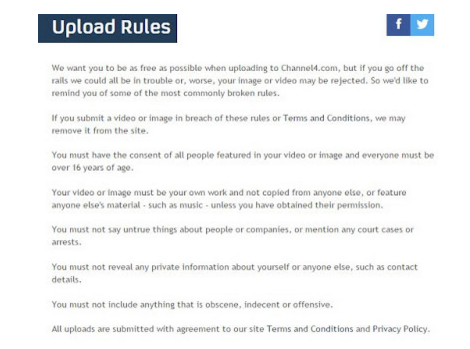
Our E-sting required no amendments as we didn't break any regulations or rules, however if we hadn't met all the conditions and rules set out on the website as seen below we would have had to amend the sting to suit them. These are the "house rules" of uploading. All of these must be followed and if not it will result in your media text being taken down.
The budget for a brief and your fee for responding to it may be subject to change for a number of reasons. A common reason may be due to an under estimation of how long a project will take to complete. If a project takes longer than expected, at no fault of your own, you may need more funding to the complete the job, and this may effect your fee in a negative or positive way. Another reason your fee may increase is if you complete the brief ahead of schedule you may be rewarded with a bonus of sorts. When in the middle of responding to a brief you may also be contacted by the company you are working for to add something extra to it; in a way they have now extended the work load and this will require a higher budget and also a higher fee due to the increased work load.
Opportunities
There are many reasons why people respond to briefs. The most common of course will be for payment and to do so for a career.
However outside of the professional production world there are also other reasons to respond to a brief. When first starting out in the industry it is important to have relevant experience in order to improve your skills and show potential employers you are competent and interested in the field. Responding to unpaid briefs is an excellent way to do this.
Lastly many briefs appear in competition form just like the E4 sting competition. Many competitions offer prizes as incentives which entice people to respond. These rewards could go on to fund future independent projects of your own.
Responding to this brief allowed me to improve my skill with animation techniques and camera techniques. I learned just how small the incremental movements have to be to to create fluid motion, especially when animating a human character. I also developed my skills using the camera particularly with regards to the lighting using the ISO and aperture to achieve the lighting level we needed.
(read through and relate more to the brief ie what we could and couldn't do. also talk about target audience more and mention demographics and psychographics)
To review my animation I will produce a written report as I feel this will be the way in which I am most able to effectively evaluate the animations achievements and short coming in a concise and efficient way. It will also allow me to go more into detail than an oral presentation would, which may require a more vague description because of wanting to remain unambiguous.
Once our animations were complete we chose to distribute our work on the streaming site YouTube. This was the obvious method as it offered us the chance to reach the biggest audience we could, as well as the fact it is an easy and simple way of displaying work to the public. We also displayed our work in college, screening to to our fellow peers who then gave us constructive criticism via the YouTube comments seen here.
This was an effective way to gain an immediate response from our audience that had the benefit of giving us that immediate gut feeling about the film. As we can see the majority of the feed back was very positive with people saying they really enjoyed the concept of the idea and that the movement of the character in particular was very good. Our negative comments were mostly about some of the lighting which believe would have been due to slightly different lighting levels of the location we filmed on rather than errors with the camera.
We also created a questionnaire to distribute on social media sites and to email people as to acquire feedback from the public. The questionnaire we devised was designed to find out what audience most affiliated and liked the sting, if the audience were able to identify the genre, narrative, and style, and also whether they felt the sting was technically up to rate in regards to the smoothness and lighting. Our feedback was mostly positive and this was especially pleasing as the people reviewing us were the public, and so would be a lot more harsh if they felt there were mistakes.
The first two questions asked the audience their age and gender, this was as both could influence the results we receive from the other more telling questions, and it would also be interesting to see what age groups and genders were most interested in the film. In regards to gender we got a reasonably even amount of feed back from both male and female participants. However in regards to the age groups that responded our participants were almost exclusively from the 18-24 group, presumably this was because the questionnaire was emailed to people we know, and therefore the majority of respondents were our friends of similar ages. We did however gain some answers from the other age groups, which we hypothesise were probably YouTube viewers as it was exposed to a wider age ranged audience.
Question 3 asked participants what genre they felt most accuracy described our animation. Our original idea for our sting was that it should contain some amount of humour, as this reflected the many of real e-stings we saw which were humorous in nature. Pleasingly the majority of our participants identified the sting as being part of the comedy genre. Another reason we felt using humour was a good idea is because people become more engaged if they are entertained and we think it worked well.
We featured a comment section to ascertain exactly what each individual found funny about our sting. It also explains why 2 people suggested it was action and 1 person suggested it had more of an adventure genre and this is important as it suggests amendments we could make in order to improve it. The comments also show the narrative was understood and that the audience were able to correctly identify the plot, which suggests we were able to convey a narrative in a short space of time that is engaging.
This question was perhaps slightly more aimed at those with some background knowledge in animation, asking whether they were able to identify which type of animation it was. However it was perhaps obviously Lego animation due to the Lego character. There was one anomalous response which suggested it was a claymation however this could be due to the use of blu tac or the paint at the end which may have been mistaken for clay.
Question 6
This question was designed to find out whether the audience could correctly identify what the character was, as him being an artist was vital to the story to give it context. It also asked what age they felt the character was, and the gender.
The audience were able to identify the character as an artist/ painter and decorator, which for the most part was what we had planned and decided to make him. The name of the e-sting was also "The Artist" which may have hinted at this.
Asking what age they though the character was helped us understand how an audience would interpret the character. We hadn't planned on there being any set age for the character, and the responses we got ranged from the 20-40 range with most being at the latter end. This may be due to peoples stereo typical views of artists in general, however I personally happy we got a range of answers, as this meant each individual had their own personal ideas about the character.
In our original planning the character was to be a male artist, this tied in with the artist losing his temper and being a grumpy frustrated man at the end, stereotype that can be humorous. All participants were able to identify the character as male meaning we designed our character well.
This question was really to ascertain whether the technical and precise movements required to make animation smooth were done well enough, in other terms the frame rate. Obviously animations aren't supposed to be as smooth as real life, however it was important that we captured real and in this case human movements. The results we got back were very interesting and on the whole positive with 81% saying they the animation was smooth, however 5 of our participants told use it wasn't. This suggests some improvement was needed and also suggests to us certain things we could change to achieve a smoother animation.
This question was designed to help us figure what was good about the sting and what wasn't, which would allow us to improve on the bits that weren't as good. The image above shows the positive comments and why participants felt they added to the sting. The part that seemed to be most liked was the revealing of the E4 logo at the end of the sting, which also happened to be what took most time to capture. it was made to seem as if the logo was emerging through mess of paint. Admittedly this part was easier to shoot than the rest of sting, as were working with still canvass on the floor, as opposed to an upright canvas that had been secured with not so sturdy masking tape. However it still took a long time to shoot and so these comments saying it was done well are very positive bit of feedback.
Also rewarded was the originality of the idea itself, which again was very pleasing as this meant the sting may possibly stand out and therefore be remembered by audiences. We also felt this way as prior to coming up with our own sting we analysed already existing ones, and there wasn't anything on the same lines as our own. One idea we did borrow however still execute in our own way was the slow revealing of the E4 logo.
This shows what people didn't like about the sting and why. The most frequent dislike is also one that I share and is to do with the lighting. In the first sequences there are moving shadows that are visible on the canvas, and this was due to ambient light and different movements that were going on in the class we were filming in, a way to improve this would have been to film when the class was empty, however this wasn't really possible to due the time frame we were working with. We also tried using different filters on premier pro to make the shadows and lighting look better which worked, however couldn't completely negate any shadows without ruining the lighting on the whole.
This question was perhaps answered in the "what do you like section" however at the time we weren't aware it would be one of the major positives, so we felt it necessary to ask whether people felt the idea was unique. In correlation to previous feedback all but one person said they felt the idea was unique, which is obviously a major positive as it sets it apart from any other stings. The sting was also created in part to be entered in to a competition so originality was important.
We also wanted to know exactly was they felt was unique about the the sting. The responses above mostly stated that they hadn't seen any like it before as mentioned previously which was a very positive thing as this makes it stand out, and we had purposely done research and made sure our idea wasn't too similar to any others. Another was that it combined both pain and Lego animation together which was different to most, and it was also said that our characters realistic movement gave him a character made it stand out.
This was simply to find out whether we had created a media text that could be identified as a channel ident- e-sting. Thankfully 100% of people said it was easily identifiable as an ident. This is important as it suggest our work isn't of ambiguous genre or purpose. Also notable is that most of our participants are around the 18-2 age the same age group E4 is aimed at.
Evaluating the project
When creating our e-sting we came across a few obstacles that had to be dealt with, one of the biggest being that the materials we were using were fragile and broke easily. We began to construct the ladder with cotton bud sticks sellotaped , however this was unstable and didn't look good when we began filming, and fixing this took a lot of time. The pre-production work also became difficult with regards to meeting the deadline. We tried then to amend our design of the ladder using cotton buds, however cutting the tips off to make it look more realistic and instead of using tape, we used blu tack as this was more effective and allowed us to fix the ladder in place on the floor
Our next issue was fixing the camera and canvass in place, as keeping the same position for each shot was vital in order to create a smooth picture. However we shared a classroom and on several occasions our tape markers had been moved either by cleaners or other students, resulting in us having to find the correct position and marking it again, a very time consuming process. We also had the issue of filming on a low down surface thus meaning we were unable to use a tripod as none would lower to the required height, resulting in us having to use a box and mark where the box was and where the camera was on that box. These issues took up a lot of our filming time, however we did manage to stick to the deadline for filming.
The problems we faced while editing mainly were to do with certain shots we had got had shadows that moved positions due to certain extraneous factors in the class room like people moving around behind us. To remove these we had to place colour correction and fix the RGB setting to make these less prominent. |Also two of our images had an orange tint to them, to amend this we used filters and also altered the colour of our other images to make the colour and shading the same throughout. Also staying with in the 10 second limit was also a hard due to the amount of footage we had, after ordering every frame we actually had around 15 seconds worth of footage, which resulted in us having to cut certain parts of the sting. The original plan for our e-sting was for the the artist to kick the canvas resulting in it falling over and the paint falling off to reveal the E4 logo, however because we ran over time we had to think about which part we could condense to have the same effect. We decided to cut the frames of the board falling over, these frames were also quite jumpy so we thought it was best to remove these and just get the character to kick the board and then the paint fall off from that action and reveal the E4 logo, this took our e-sting down to 13 seconds. Therefore we had to cut a few other frames out that could be removed, we took out and made shorter the part where the character was frustrated and threw his hands in the air, this eventually took it down to 10.1 seconds.
The timing for filming was from the 18th of November to the 25th of November, through the setbacks of the constraints we still managed to keep the the deadline for pre-production, filming and editing. However the pre-production did take the most time because of the materials we used and collecting the paint as well to paint the canvas and paint over the masking tape, there was pre-production happening throughout some of the filming because of the different parts of the story that were being filmed. for example the canvas had to be plain to begin with, therefore we couldn't paint the canvas until we were up to that point of filming, we then had to check over the images to check that they were completed before we painted the canvas, as once painted we could not go back and redo any shots in front of the plain canvas.
In regards to legal constraints we faced the sound track was a major one as we were only allowed to use music that was from a pre selected set of tracks chosen by E4 due to copyright laws and this also ensured any music used would sound similar to that already featuring in existing e-stings. E4's guidelines stipulated that we had to use their soundbites for the animation and so this meant our creative freedom was limited slightly. If we had used music that wasn't from the selection of soundbites our e-sting wouldn't have been valid for entry.
The reason for the E-sting to follow these guidelines on the soundtrack is because once submitted the E-sting is therefore part of the E4 copyright protection, therefore making it illegal for anyone to copy the work you have produced and re-submit it. It also again identifies E4 as a brand which is obviously the purpose of an E-sting. below are the 'House Rules' for which an E-sting must adhere to.
Here we see the house rules stipulate that any work submitted must be your own work and not that of another persons nor can it be copied or feature anyone else's material without permission. This is a guideline that ensures E4 abide by legal copyright law and prevents them from being subject to copyright infringement claims. Below you can see the E4 guidelines in relation to copy right infringement which covers anything from copying, distributing or making profit of anyone else's ideas no matter how substantial the piece of work.
For our animation we had to be aware of the copyright law and also research on YouTube and the E4 E-sting website itself, to watch various E-stings that had already been made to get inspiration, but to also be aware of ideas that had already been made. This included using the same title, same story line, the music was not as much of an issue because all E-stings were specified to use music provided. The idea of our E-sting came from seeing a recurring theme of the revealing of the E4 logo, and to think about how we could do it, with a clear story line told within 10 seconds. The legal considerations restricted us from re-creating someones idea and even producing it with different materials, if it was one that already exists and you submitted that, it would be an ultimate disqualification.
For my original idea for an Esting I wanted to use paint on a canvass whilst incorporating a Lego figurine to appear as if he was painting the E4 logo. I would do this by using stop motion animation to hopefully produce a humorous short. The idea behind this came from practical experience after having made short films using live action and Lego. I realised I liked how the Lego characters moved encouraging me to implement them in my Esting as they we easier to control compared to plasticine characters. The idea for using paint on canvass came from having seen it used before in stop motion animation and really being impressed with how it looked, and I feel it may make the sting stand out. I also thought the paint would be good for forming the E4 logo that must be shown at the end of of the sting as required to meet the brief. It is also important that the story isn't too complex or long as there is a ten second limit on the E-sting. I believe the narrative of my planned sting will be simple enough to fit within this limit.
There are terms and conditions that apply to the Esting competition which can be seen here: Terms and conditions
Here is a print screen of some of the most important terms and conditions.
Here we see rules of using music and it is stipulated that you are only allowed to use music from a selection of already chosen songs.
Also stipulated is the formats which they accept which can be seen above.
We also see some more below:
We see here stipulated age which you have to be to enter the competition as well a rule stating you cannot use anyone else's material within the sting you create. (State how this sting abides by channel 4's requirements) Questions.
The format we will use to create our stop motion animation utilising acrylic paint on a canvass to create our E4 sting. We have chosen to use stop motion and paint because after doing research we have seen how amazing it can look and that it really captures the audiences attention. We have produced our recce stop motion films we realised that Lego was also another great and simple way to create a good stop motion film. Therefore we have decided to also use a Lego figurine in unison with the canvass and paint. We also felt that this method of animation would suit the channel which is a less serious and light hearted one, and we felt this fit the brief as it was stipulated that we make the sting appeal to the audience of the channel
The brief narrative of our E-sting focuses on a Lego character as an artist standing on a ladder leaning on a canvass. We see him meticulously placing masking tape on the canvass to make the E4 logo, however at the time this will be unknown to the audience. The Lego character after completing his masterpiece and then suddenly sneezing resulting in the ladder falling and his paint bucket flying in the air splatting all over the canvass. To produce this bucket flying effect we will use blue tac to keep it in position. the splat effect from the paint will be made by flicking paint off of a brush. After seeing the destruction his sneeze has caused the Lego man will frantically kick the canvass out of frustration causing it to fall over. We will then cut to a birds eye view of the canvass flat on the floor, the masking tap will peel off due to the momentum of the fall revealing the E4 logo. I feel this narrative will fit within the allocated time limit of ten seconds stipulated within the requirements of the brief
Our animation will be set on the canvass which in effect will be the entire diegesis of the short. We will also see the a small part of the floor which his ladder will be placed on whilst leaning on the canvass. The Lego man will
A potential limitation will be producing fluid movement in regards to the figurine climbing up the ladder, as well as creating the movement of the bucket flying and covering the canvass in paint. The filming will also be very time consuming an will possibly require multiple days of filming. This will mean we will have to maintain our scenes over night as to not produce any continuity errors. We also have a 10 second length which may be hard to stick to because of the complex movement that are involved. Lastly as we are using Lego pieces we will have to make sure we use an unmarked character as to not breach any copyright laws. This will be easily done and we will be able to create a distinctive character using paint to create facial expressions.
It is stipulated in the terms and conditions that we must use a sound track that is part of a selection Channel 4 have chosen. This is so no copyright infringement occurs and also that all the stings have a similar feel to those channel 4 have created. We of course abided by these rules as to make our sting valid.
Target audience
Taking into consideration our research into E4's target demographic we will accommodate to their use of humor as to match the target audience. This will mean our target audience will be the 16-24 year old range .This audience will also be familiar with Lego as most would have had experience with it in their childhood. Also the use of paint on a canvas inserts a creative flare into the sting which may appeal to the younger and more creative members of the target audience. A large portion of 16-24 year olds will be students and so it could be argued the use of paint may strike a chord with Art/Media subjects students.
E4 is a British digital television channel, launched as a pay-TV companion to Channel 4 on 18 January 2001. The channel is therefore owned by Channel 4 and aimed at the 15-35 age group, and perhaps ranging from E to certain members of the C1 demographic socials classes, with being students being their primary target audience and the rest of the classes being the secondary audience.
E4 airs American programmes like, The Cleveland Show, Desperate House Wives, Scrubs and formerly Friends; and also British shows such as Skins, Made in Chelsea and The Inbetweeners. Its most successful broadcast to date was on 11 October 2010 when an episode of The Inbetweeners pulled in over 3.7 million viewers.
The channel also owns E4+1 a duplicate of E4 which is 1 hour behind, More4, Film4, 4seven, 4 music and Shorts all of which are aimed at similar audiences to E4 apart from Film 4 which shows a variety of classic and old films appealing to a wider demographic. Paragraph 2
E4 sting is similar to a channel ident appearing before and after TV shows to remind viewers of the brand forming brand association with the popular television programmes they show.
Duck hunting E-sting.
This E-sting is very comical with striking visuals such as the overtly stereotypical features of the farmer and the humorous ending. The surreal visuals help gain the audiences attention in the first place. Using humour associates the channel with lightheartedness and not taking it's self to seriously, which the target audience being students may find attractive. The E4 logo also makes an entrance towards the end for the purpose of identifying to the audience that you are watching E4.
I like the humorous content of this E-sting as it represents what the channel is about and who its for giving it identity.
Singing horse.
The singing horse is part of a series of E-stings featuring him. Again like before we have a very odd, humorous narrative with striking visuals attempting to identify the channel as a sort of joker which may appeal to the target audience, which i would say was in between the 15-30 age range and particularly constituting of students. The use of animation allows for the surreal look of the sting and again emits the idea that the channel doesn't take its self to seriously.
I personally don't like this E-sting because of it's random and frankly stupid nature and it doesn't appeal to me personally.
Drums.
This sting uses black and white animation on a purple background, and again is humorous with the cartoons and surreal visuals. The use of the purple also identifies it as belonging to E4 as this shade of purple is used both by E4 and channel 4 for their logos and features in most programmes. We also have the repetition of "E4" again reminding the audience what channel they are on and who the content belongs to and is associated with.
To practice utilising the stop motion animation we made a live action stop motion short. The basic premise of the the short was a man skating on a wet floor sign. This gave us an insight to just how precise the incremental movements have to be as well as how many photos are required to produce a fluid enough motion picture. We also learnt about how camera positioning can affect the flow off movement and that the position of the camera is just as important as the slow and precise movements that are required. Here is our practice attempt at live stop motion animation:
We also designed and made basic animation devices that had been used in the early stages of animation. These devices included the thaumatrope, praxinoscope and zoetrope and work because of the basic concept of persistence of vision. The idea being to create images of the same thing in slightly different positions, placing them in a certain order and displaying them all separately but in quick succession to create a fluid movement.
We then used Lego to create a ten second short. Again this required moving a figure in incremental movement and taking pictures of each placement. Here we also learn of how precise and minute the movements must be in order to create a fluid image once the pictures are put together. Working with Lego makes for an easy and if done properly efficient way of creating stop motion animation, however the more complex and realistic movements are obviously harder to create due to the nature and lack of malleability of the material.
Having looked at already existing E-stings and seen that all are surreal and humorous, I have chosen to produce an E-sting using a Lego figurine, as for an E-sting realistic movement isn't vital and it offers an easier way to produce an quality stop motion animation. Although the other methods are all viable, I feel they are easier to get wrong than using Lego, which offers greater control.
A circular shaped piece of car or other material has a picture or drawing on each side and is attached to two pieces of string. When both strings are twisted rapidly between the fingers the two pictures or drawings appear to blend together into one picture due to the piece of card moving to quickly for the eyes to detect the movement. This is called persistence of vision
Common Examples of Thaumatropes are a bare tree on one side and its leaves on the other, or a bird on one side and a cage on the other.
They can also contain riddles or short poems, with a line on each side. Thaumatropes were just one of many optical toys that used persistence of vision. They are thought of as the early seeds that have led to modern day cinematography and in particular of animation.
The invention of the thaumatrope is credited to one of either John Ayrton Paris or Peter Mark Roget. Paris used one demonstrating persistence of vision to the Royal College of Physicians in London in 1824.He based his invention on ideas of astronomer John Herschel and geologist William Henry Fitton. Some sources attribute the original invention to Fitton rather than Paris.
In 2012, there was a report that a prehistoric thaumatrope had been discovered in caves in France, particularly the Chauvet Caves.
Phenakistoscope.
This was another early toy that used stop animation. The phenakistoscope used a spinning disc attached vertically to a handle. Around the outside of the disc was a selection of pictures showing different stages of an animation, and cut through it were slits that were evenly separated . The person using it would spin the disc and look into the moving slits at the drawings on the disc's reflection in a mirror. The slits across the reflected images stopped them blurring together, meaning that the viewer would see a succession of images that looked like a single moving picture.
Although this principle had been recognized by the Greek mathematician Euclid and later in tests by Isaac Newton. It wasn't until 1829 that this idea was firmly established by Belgian Joseph Plateau. He planned it in 1829 and made it in 1832.
Zoetrope.
The Zoetrope is made from a cylinder with slits cut straight down in the sides. On the inside of the cylinder is a band with pictures from a sequence on it. As the cylinder turns or is spun, the viewer looks in to the slits at the pictures across. Again the slits stop the pictures from simply blurring together, and the viewer sees a succession of images, giving the illusion of motion.
A device which a historian of Chinese technology called "a variety of Zoetrope" was created around 100 BC by the inventor Ding Huan, but the specific nature of the device, which has been misreported in other reports, and the historian's definition of "a variety of Zoetrope" it's self is inconclusive.
The Zoetrope shape was first made in 1833 or 1834 by British mathematician William George Horner. Aware of the recently made and quite familiar Phenakistoscope disc, Horner's revolving drum also had viewing slits between the drawings. He called it the "daedaleum". The daedaleum however didn't become popular until the 1860s, when a similar device with the viewing slits on a level above the pictures, allowing the use of replaceable strips of images, was made and copyrighted by English and American inventors.. The American inventor William F. Lincoln called his device the "Zoetrope", meaning "wheel of life".
Praxinoscope
The praxinoscope, another animation, and upgrade of the zoetrope. Created in France, 1877 by Charles-Émile Reynaud. Similar to the zoetrope, it utilised a strip of images located around the inner side of a spinning cylinder. The praxinoscope progressed on the zoetrope by removing its narrow viewing slits and instead implemented an inner circle of mirrors, located so that reflections of the images looked fixed in position as the wheel turned. Looking in the mirrors would therefore show a quick succession of images producing the illusion of motion, with a brighter and less distorted picture than the zoetrope had previously had.
In 1889 Reynaud further improved on the idea creating the Théâtre Optique, an upgraded version enabling the projection of images on a screen from a longer roll of pictures. This in turn enabled him to show hand-drawn animated cartoons to larger audiences. Alas Reynaud's device was soon eclipsed in popularity by the photographic film projector of the Lumière brothers.
Kinetoscope.
The Kinetoscope was an early motion picture viewing device. The Kinetoscope was made so that films could be viewed by one person at a time through a peephole at the top of the device. The Kinetoscope wasn't a movie projector but did create the basic method that would later become the standard for all cinematic projection before the creation of video. By creating the illusion of movement by showing a strip of film with small holes in it having sequential images on it over a light with a high-speed shutter. Described by U.S. inventor Thomas Edison in 1888, it was largely developed by his employee William Kennedy Laurie Dickson between 1889 and 1892. Dickson and his team at the Edison lab also devised the Kinetograph, an innovative motion picture camera with rapid intermittent, or stop-and-go, film movement, to photograph movies for in-house experiments and, eventually, commercial Kinetoscope presentations.
Part 2- The developers.
George Pal.
George Pal was born om February 1st 1908 and died in May 1980 and was a Hungarian animator and film producer, primarily focusing on the use of stop motion animation with puppets. He became an American citizen after emigrating from Europe.
He was nominated for Academy Awards throughout his life and for seven consecutive years (1942–1948) receiving an honorary award in 1944.
He was most famous for his use of puppets in stop motion animation. Here is an example of his work in Tulips Shall Grow (1942)
Willis O'Brian
Willis Harold O'Brien was born on March 2 1886 and died November 1962. He was an American special effects and stop-motion animation pioneer, responsible for some of the best-known images in cinema history remembered for his work on The Lost World (1925), King Kong (1933) and Mighty Joe Young (1949), for which he won the 1950 Academy Award for Best Visual Effects. He used clay figures that he sculpted and these were featured in the films he made. here is an example of his work in The Mighty Joe Young (1949)
Phil Tippett.
Phil Tippett born 1951 is an American movie director and a visual effects supervisor and producer, who specializes in creature design and character animation. Tippett was born in Berkeley, California. When he was seven, Phil saw Ray Harryhausen's special effects classic, The Seventh Voyage of Sinbad, and knew from that day what he wanted to do. He completed a bachelor's degree in art at the University of California, Irvine. Phil went to work at the animation studio Cascade Pictures in Los Angeles. He also went on to make figurines made from clay used in claymation that featured in films such as Star Wars: A New Hope (1973)
.
Ray Harryhausen
Raymond Frederick "Ray" Harryhausen born June 29, 1920 dying May 7, 2013 was an American visual effects creator, writer, and producer who created a form of stop-motion model animation known as "Dynamation."
His most memorable works include the animation on Mighty Joe Young (1949), with his mentor Willis H. O'Brien, which won the Academy Award for Best Visual Effects; The 7th Voyage of Sinbad (1958) and Jason and the Argonauts (1963), featuring a famous sword fight against seven skeleton warriors. His last film was Clash of the Titans (1981), after which he retired.
Harryhausen moved to the United Kingdom and lived in London from 1960 until his death in 2013. Here is an example of his work
Otmar Gutman
Otmar Gutmann was a German television producer, animator, and director. He is most known for his long-running creation Pingu in which he crafted out of clay figures in which he would bring to life using stop motion animation. Here we can see his creation in action.
Tim Burton and Henry Selick
Henry Selick is an American stop motion director, producer and writer, best known for directing The Nightmare Before Christmas, James and the Giant Peach and Coraline. He studied at the Program in Experimental Animation at California Institute of the Arts. Tim Burton is the director of all of the above and always works with Henry Selick when producing a film utilising stop motion animation technology. Selick mainly works with clay models as seen in this clip of The Nightmare Before Christmas.
Adam Shaheen.
Adam Shaheen is a British animator, television producer and screenwriter. He is the founder and owner of Cuppa Coffee Studios where he develops and produces programming.He is also the executive producer of Cuppa Coffee’s award winning broadcast design and commercial studio.
Shaheen has produced over 200 commercials, winning over 150 International awards - including 3 Gemini's/Canadian Screen Awards for his contribution to Canadian Animation and also the Prix Jeunesse, the prestigious international award given at Annecy. Shaheen is widely considered the single most awarded executive in the field of animation. He mainly uses clay figures and here is a short piece of work produced by Cuppa Coffee Studios.
The Quay Brothers.
The Quay brothers are both influential stop motion animators that work mainly with clay and also real life objects. They have a very gothic eerie style and many of their films are have dark narratives. Here is and example of their work Streets of Crocodiles.
Nick Park
Nick Park is an English director, writer, and animator best known as the creator of Wallace and Gromit. Park has been nominated for an Academy Award a total of six times, and won four with Creature Comforts (1989), The Wrong Trousers (1993), A Close Shave (1995), and Wallace & Gromit: The Curse of the Were-Rabbit (2005). He works with clay models as we can see here in this clip from Wallace & Gromit: The Curse of the Were-Rabbit (2005).
Fantastic Mr Fox.
Fantastic Mr Fox is a feature film and uses puppet models for its stop motion animation. The film tells the tale of a group of animals conspiring against evil farmers who are planning to destroy their habitat for farm land and is aimed as children and families. The film uses stop motion animation as it gives the film an authentic real look as opposed to using a computer generated cartoon adding to the quirky identity of the film. It also is an easy fix to having a film where the main character are animals being more easy then using real animals.
Chicken Run.
This film uses clay models for the stop motion and does so to achieve the humor and feel to the film enabled by its use. It also makes possible human movements within the animals featured triggering us the audience to connect with them.
Creature comforts.
This like the previous film mentioned is another creation Nick Aardman but a TV show and therefore many of the reasons are similar. The use of clay enables creatures such as the flees featured in the clip above to have human personalities that the audience can get to know. This show was aimed at adults due to some of the humor included however older children could also possibly enjoy it due to the entertaining visuals.
Clay Kids
Clay Kids uses clay figures and environments to produce movement through stop motion. Its audience is children and the overstated comical features of the clay figurines support this.
McCoys's crisp advert.
This advert utilises stop motion animation to bring the crisps (the product) to life, letting the branded McCoy crisps in to the bag and imitations are barred from entering the bag. This suggests the branded crisps have a higher quality and therefore have prestige. The use of stop motion animation allowed for this narrative to take place.
Xbox Advert
This is an advert for Xbox using clay to create different objects that represent games available for the console. The use of this stop motion animation looks very fluid and impressive and by association this reflects on to the Xbox brand. It also enables the characters associated with the games to be brought to life perhaps subtly suggesting that the only limit is your imagination and that you the player can sculpt your experience.
Moving on music video.
This video uses string environments and figures to tell the story of a person in hospital and their passing. The video being a music video could be aimed at anyone who likes the genre of music however the use of string could be seen as a metaphor for life having a certain length.
Thinking out loud lyric video.
This is stop motion in a very simple form, using paper and drawings to display lyrics and visual cues. Although no the most creative use of stop motion the video is effective and clearly aimed at fans of Ed Sheeran's music.
https://www.youtube.com/watch?v=4wB9-rD2WUk
Shaun the sheep ident.
This is an ident for CBBC featuring Shaun the Sheep. Its audience is clearly children and viewers of CBBC due to the logo appearing multiple times and the graphics depicted in the ident.
Unofficial BBC 2 ident.
Here we see the use of clay to animate the number two. It is a Christmas one taking advantage of the season aiming to create and translate the festive feel to the audience. The audience would clearly be viewers of the BBC 2 channel.




 Paragraph 1


 .


