Showing posts with label F.Screen plays. Show all posts
Showing posts with label F.Screen plays. Show all posts
Friday, 15 January 2016

Wednesday, 6 January 2016
The commissioning process
Commissioning Process.
A royalty is a payment made by one party (the "licensee"), which in this case would be a film studio such as Paramount or Universal, to another that owns a certain property (the "licensor") which in this case would be the writer who owns the screenplay, for the right to sustained use of the property in question. Royalties are usually agreed as a percentage of the gross or net income attained from the use of the property; or a fixed price per unit sold of the property.In basic terms a royalty payment type is the method of continuous payment for any use of the property in question.
Most professional screenwriters attain work through agents. An agent's job is to find work for the screenwriter. For example a film studio might contact a writer's agent with a proposal for the writer to produce a screenplay about x. The Agent will then approach his client (the writer) about the idea asking him whether he is interested in writing the script or not. Pay and other contractual issues such as dead lines will be discussed and if an agreement is made the job will go ahead. Alternatively the scriptwriter can produce a screenplay on his own and approach his agent to distribute it. The agent will then approach different film studios to see if they are interested in producing the screenplay into a film.
Producing a movie is obviously a very expensive process and so every day is vital. This is the same in regards to script writing. The production of a film is on an extremely tight schedule and so the writer must abide by certain deadlines set by the film studio and the executives. Different writers tackle this in different ways. Some like Suri Krishnamma have said they prefer to treat writing a script as a 9-5 job,as this gives them a cemented structure as to when they will work on the script.
However there are writers that prefer an approach that is structured differently.
Quentin Tarantino for example says he likes to write during the day until he has either finished the scene he is creating, or until he gets to a point in which he runs out of ideas on how to continue a scene. At this point he says he retreats to his pool and begins to develop ideas of how to continue. He then writes down notes of his ideas which turn into his work for the next day. An interview can be seen below in which he goes into further in detail whilst talking about his new film The Hateful Eight (Quentin Tarantino, 2015).
In short the way in which a writer paces himself/herself is largely down to personal preference and these two examples show case this. There will however there will always be deadlines they have to work to.
Legal issues
Copyright
As a writer there are legal and ethical issues you must be aware of. One of the most important is that of copyright law. If a script is copied or used without the copyright the owner of the original script can sue whoever has stolen, copied or used the script for large amounts of money. An example of this happening can be seen with film Jingle all the way (1996).
 It was teacher Brian Webster who claimed he had sent a script to the production company two years before and received no payment for the script for the rights. He claimed the company had used this script to produce the film which ended up grossing $183m. The company was found guilty of breaching copyright law and ordered to pay Webster $1.5m.
Plagiarism
The same can be said for plagiarism (The exact copying of a piece of work) which can also result in huge fines for companies if they are found liable. This took place with American TV show New Girl which airs on Fox. Two screen writers stated that they were responsible for creating the show which they had originally named "chapter one".
 As seen this example shows a scenario in which plagiarism can take place and the potential consequences that can occur and the action available to take if you feel your property has been copied.
Bias
Bias is another legal issue that can result in law suits being filed against production companies. It often refers to when a film depicts a real life person, and if the person feels they are unfairly represented in the film it may lead to them filing a law suit for defamation of character.
 Here we see an example of a film in which perhaps didn't portray events in a fair way, which lead to a law suit against the makers of the film. This shows the importance depicting true life events in an unbiased way, and remaining impartial.
Libel
Libel is similar to bias however is a direct statement rather than a purposeful misinterpretation. Often relating to a statement or declaration about an individual that is not true.
A recent example in which this may have occurred is with biopic Straight Out of Compton (2015, F. Gary Gray). Jerry Heller was NWA's manager, and was depicted in a negative way in the film and filed a $110m libel suit against the makers of the film.

Job Roles within the commissioning process.
Commissioning editors
Commissioning editors will be employed by film studios and there role is to seek out potential screenplays that might be produced into a film.
This occupation is a mid/senior-level post requiring suitable experience and ability.
Typical work activities
Commissioning editors are involved with a project at every stage. They are the key link between the initial proposal for a book or product and the published work.
To develop their publisher's list, commissioning editors research their field in order to learn about trends and gaps in the market. For this purpose, they attend book fairs;conduct internet research;draw up surveys to identify demand and attend conferences
Work activities may include developing a publisher's list of titles for a specific genres, managing the list in the current market as well as identifying future markets and new products and titles with commercial potential. It will also require researching developing market trends on a national and international level and identifying, developing and supporting projects and authors, meeting with other commissioning editors and senior editors to discuss new proposals, reading and evaluating book proposals and manuscripts offered by authors and agents, as well as assessing their suitability for the list. They will also be involved in negotiating contract terms with authors and agents; liaising with authors and reviewers throughout the production; maintaining a book-publishing programme and monitoring progress throughout the publication process; organising book launches and signings; working with administration, finance, budgets and strategy;providing data and contributing to marketing and sales activities; managing the 'back-list' of titles already published articles and making decisions on whether to reprint, revise, make a new edition or put out of print.
Producers
Producers have overall control of all aspects of a films production and are accountable for the overall success of a film. They are often involved in all phases of a production and are sometimes the first person to become involved with a project. In regards to screenplays they are normally the person who decides and chooses what screenplay will be made into a full film. They will also choose the screenwriter and the story editing team whilst securing any rights required to further the production. Perhaps most importantly they are responsible for attaining any funding necessary for the films production.
In pre-production, Producers are the ones who bring together the most important members of the team. This includes the Director, Cinematographer and Production Designer and key cast members. They also help the Executive Producers to raise money for the production. Once the initial finance is in place, they select other key production office personnel and Heads of Departments.
Producers also are responsible for approving locations, studio hire, the final shooting script, production schedule and budget. Spending more time and money on the pre-production can often save more money during the actual production.
Once the film is in production, Producers are responsible for the day-to-day smooth operation of the team. Producers will be in continuous communication and consultation with the Director and other key creatives, on and off set. Producers approve all script changes and cost reports which of course often affect the screenwriter. They are the first point of contact for all production partners, investors and distributors.
During post production, Producers are expected to liaise with the Director and post production department. The Producer will deal with the finance and distribution companies in planning the marketing and distribution of the finished film.
Director
The basic role of a Director is to be the driving creative force in a films production, visualising and defining the overall style and look of the film, and then executing it. They will also be included in other roles such as cast selection, script editing, shot composition, and choosing what shots to use in the editing process. They are also the key link between the production, technical and creative teams.
Directors are in charge of turning the film's script into visual images and sounds on the screen. They are responsible ultimately for the films commercial success and overall creative direction.
Directors may also write the screenplay as well as commission it, or may be employed after an 1st draft of a script has been made. They are then the person in charge of developing a vision for the finished film and devising a way in which to achieve it.
Whilst in pre-production, a director will make important creative decisions, such as choosing the cast, crew and locations for the film. A director will then direct rehearsals and the performances of the actors once the film is in production.
They will also have to manage the technical parts of filming including the camera, sound, lighting, design and special effects departments.
During post production, a director will work closely with the editors through the many technical processes of editing, to reach the final cut or version of the film.
At all stages, a director will be responsible for making sure all members of the production are motivation and that morale is high in order to produce the best final product possible . Directors must also always be aware of and maintain the constraints of the film's budget whilst managing the expectations of the film's financiers.
Script editors
A script editors main roles are to provide a critical overview of the script writing process, liaising between the producer and the screenwriter and helping to strengthen the script in any way they can.
A script editor will mediate between the script writers creative ideas and the commercial needs of the film company, trying to find a finished product that suits both parties. They offer a different perspective and remind the script writer of the films target audiences trying to realise the full potential of the screenplay.
They are also there to aid the script writer in mapping out their story, and if needs be remind them of this map when scenes they write deviate from the plan. Script editors will often adhere to a development schedule, this will include meetings with both producers and screenwriters allowing the liaising part of the job to take place. They will also keep records of any developmental decisions made between the producers and screenwriters in order to come to a shared vision and end goal for the script.
Agents
An agent represents the interests of performers or creative members of a films production. They have the primary role of finding work for their clients and also cultivating relationships we high level persons within the industry.
An agents clients can include that of actors, Singers, Dancers, Walk Ons or Supporting Artists, Stand Up Comedians, Variety Artists, Presenters, Choreographers, Designers and Directors. This means they must have an acute knowledge of the entertainment industry.
Agents have to persuade decision makers in the industry to hire their clients, and so much of their time will be focused of establishing and maintaining relationships, using those said relationships to find work for their clients.
They have to keep up to date with the industry and know exactly what productions are taking place as to not miss out on any opportunities.
Another major role for an agent is that of coordinating their client's contracts in order to achieve the best deals they can for their clients. To do so they must keep up to date with industry rates as well as industrial agreements, whilst acting as a buffer in contractual negotiations.
Commissioning bodies
Corporate commissioning bodies will buy the rights of a script off of the writer and then put said script in to production. The commissioning body will usually be part of a corporate company and it is this part of the company that chooses which scripts are produced into films. Many scripts will often be sent into the company in question however only a small amount will have money invested into them that will ultimately lead to it being produced. Corporate companies like this attain most of their profit from box office sales, and because of this select scripts very carefully as to make sure films the films they make are financially viable. The BBC would be an example of a corporate commissioning body, especially in regards to television. They produce many scripts into programmes and movies and offer writers the chance to put forward their ideas.

Here we see the BBC advertise what sort of material they are looking for, allowing writers to respond with scripts which fit the description given. If a writer produces something the company likes then it may gain funding and be taken into the production.
Independent production companies.

These companies also produce films however usually outside of the major film industry, that being said there are some exceptions. Such companies usually produce lower budget films, often films that bigger companies won't touch as they consider them financially not viable. An example of such a company would be The Weinstein company which is a multimedia and distribution company. The company started in 2005 and was set up by brother Harvey and Bob Weinstein. The brothers had previously founded Miramax in 1979 which was also previously a independent distribution and production company before it was bought by Disney in 1993 and Quentin Tarrantino's Pulp Fiction Was released soon after. The brothers continued to run and manage Miramax with more freedom than most other Disney divisions until 2005 when the brothers decided to leave Miramax and found the Weinstein Company.The Weinstein company have produced have commissioned films such as
Southpaw (2015), The Imitation Game (2014) and also The Hateful Eight (2015). Synthetic cinema is another example of an independent production company however they work slightly differently. They sell their films to home video distributors. In-house screenwriter called John Doolan works for synthetic cinema to aid them in screen writing processes. Their main purpose is to support low budget films and amateur writers. Deep in the Darkness (2014) and Remains (2011) are examples of their work.
Competitions
Like the recent E4 sting competition we responded to, competitions can be another way in which commissioning can take place. Corporations in independent production companies will often hold competitions in which the public can respond to. In the case of a writing competition amateur writers would be able to respond to the brief and send their material in. The brief would specify the type of script the company wants and the rules and conditions that apply. The prize could be anything from money to the screenplay actually being put into production and the writer being given credit, which would obviously improve their portfolio giving them great experience. An example of such a competition would be the BlueCat competition. They offer many competitions throughout the year and an example of a screen play one can be seen below.

Role of a writer throughout a production.
The first stage of any production is pre-production. In this phase a writer takes of many various roles focusing on the script. One of these roles is script editing, this requires the writer to visit the script and often amend it numerous times in order to make sure it adheres to the wants of the production company and specifically the producers. There will often be creative discussion on what direction to take the script in although realistically it will be the producers who usually get their way, as it is their job to make sure the script aligns with the market audience. It is also essential that the writer makes sure the script doesn't deviate too much from the original story and there will also often be consultation with the producers and writers on this also. In fact through out the whole writing stage there will be continuous communication between the writing team and the director and producers in order to make sure everyone is on the main stage. This also helps the director begin to visualise his ideas for how to turn the script into a film.
There are however sometimes difficulties in the relationship between the writers and producers and it is said that it can feel like an adversarial exercise. Quantum of Solace (2008) experienced difficulties when writers strike script editing phase at a stand still. This would have cost a lot of time and therefore money for production. In the end star of the film Daniel Craig and the director had to edit parts of the script to avoid delaying the production any further.
In the film industry deadlines are extremely important as time is literally money. This means as a writer you are always working to some sort of deadline, and in order to be successful you cannot exceed them. The script is vital for production to go ahead and thus it must be ready and in a certain place at a certain time so the whole production can get under way. Script Shooting is the stage in which the director decides the types of shots he wants to use using the script as a sort of blue print to bring the transform the script in to the images we as an audience will see. Page lock down occurs when an individual page or scene in decided to be the final and used draft of the script, in short terms this means no more amendments will be made to those pages, and that they will feature in the film. Often the original script will differ substantially to that of the final draft as parts are cut or changed drastically to suit the needs of the production company. The film World War Z (2013) is an example of this happening. The original script was written by J.Michael Straczynski and differed greatly from what audiences actually saw in the film. It originally was supposed to be a humorous documentary of a zombie outbreak, however the director Mark Foster was said to believe the script was far too intellectual for most audiences and replaced Straczynki with writer David Carnahan who vastly edited the script into what became the action thriller the film was. There may be certain amendments while shooting is taking place if they are required. The writer will be present if any amendments are suggested and will often add advice on how t achieve any amendments that need making. This being said it will be down the the director and producers on what ultimately makes the cut.
A royalty is a payment made by one party (the "licensee"), which in this case would be a film studio such as Paramount or Universal, to another that owns a certain property (the "licensor") which in this case would be the writer who owns the screenplay, for the right to sustained use of the property in question. Royalties are usually agreed as a percentage of the gross or net income attained from the use of the property; or a fixed price per unit sold of the property.In basic terms a royalty payment type is the method of continuous payment for any use of the property in question.
Most professional screenwriters attain work through agents. An agent's job is to find work for the screenwriter. For example a film studio might contact a writer's agent with a proposal for the writer to produce a screenplay about x. The Agent will then approach his client (the writer) about the idea asking him whether he is interested in writing the script or not. Pay and other contractual issues such as dead lines will be discussed and if an agreement is made the job will go ahead. Alternatively the scriptwriter can produce a screenplay on his own and approach his agent to distribute it. The agent will then approach different film studios to see if they are interested in producing the screenplay into a film.
Producing a movie is obviously a very expensive process and so every day is vital. This is the same in regards to script writing. The production of a film is on an extremely tight schedule and so the writer must abide by certain deadlines set by the film studio and the executives. Different writers tackle this in different ways. Some like Suri Krishnamma have said they prefer to treat writing a script as a 9-5 job,as this gives them a cemented structure as to when they will work on the script.
However there are writers that prefer an approach that is structured differently.
Quentin Tarantino for example says he likes to write during the day until he has either finished the scene he is creating, or until he gets to a point in which he runs out of ideas on how to continue a scene. At this point he says he retreats to his pool and begins to develop ideas of how to continue. He then writes down notes of his ideas which turn into his work for the next day. An interview can be seen below in which he goes into further in detail whilst talking about his new film The Hateful Eight (Quentin Tarantino, 2015).
In short the way in which a writer paces himself/herself is largely down to personal preference and these two examples show case this. There will however there will always be deadlines they have to work to.
Legal issues
Copyright
As a writer there are legal and ethical issues you must be aware of. One of the most important is that of copyright law. If a script is copied or used without the copyright the owner of the original script can sue whoever has stolen, copied or used the script for large amounts of money. An example of this happening can be seen with film Jingle all the way (1996).

Plagiarism
The same can be said for plagiarism (The exact copying of a piece of work) which can also result in huge fines for companies if they are found liable. This took place with American TV show New Girl which airs on Fox. Two screen writers stated that they were responsible for creating the show which they had originally named "chapter one".

Bias
Bias is another legal issue that can result in law suits being filed against production companies. It often refers to when a film depicts a real life person, and if the person feels they are unfairly represented in the film it may lead to them filing a law suit for defamation of character.

Libel
Libel is similar to bias however is a direct statement rather than a purposeful misinterpretation. Often relating to a statement or declaration about an individual that is not true.
A recent example in which this may have occurred is with biopic Straight Out of Compton (2015, F. Gary Gray). Jerry Heller was NWA's manager, and was depicted in a negative way in the film and filed a $110m libel suit against the makers of the film.

Because the film was so successful this warranted the high amount claimed. This also shows the importance of representing real life people in a fair and truthful way. It may be the case film studios sometimes alter certain truths as to make the story fit in with common narratives, in this case the bad vs good narrative.
As seen committing any one of these can lead to huge financial loss for film companies, thus so it is vital that they avoid suits like this. However often these suits are settled behind closed doors and it is unlikely that the claimant will receive the money they are claiming.
Job Roles within the commissioning process.
Commissioning editors
Commissioning editors will be employed by film studios and there role is to seek out potential screenplays that might be produced into a film.
This occupation is a mid/senior-level post requiring suitable experience and ability.
Typical work activities
Commissioning editors are involved with a project at every stage. They are the key link between the initial proposal for a book or product and the published work.
To develop their publisher's list, commissioning editors research their field in order to learn about trends and gaps in the market. For this purpose, they attend book fairs;conduct internet research;draw up surveys to identify demand and attend conferences
Work activities may include developing a publisher's list of titles for a specific genres, managing the list in the current market as well as identifying future markets and new products and titles with commercial potential. It will also require researching developing market trends on a national and international level and identifying, developing and supporting projects and authors, meeting with other commissioning editors and senior editors to discuss new proposals, reading and evaluating book proposals and manuscripts offered by authors and agents, as well as assessing their suitability for the list. They will also be involved in negotiating contract terms with authors and agents; liaising with authors and reviewers throughout the production; maintaining a book-publishing programme and monitoring progress throughout the publication process; organising book launches and signings; working with administration, finance, budgets and strategy;providing data and contributing to marketing and sales activities; managing the 'back-list' of titles already published articles and making decisions on whether to reprint, revise, make a new edition or put out of print.
Producers
Producers have overall control of all aspects of a films production and are accountable for the overall success of a film. They are often involved in all phases of a production and are sometimes the first person to become involved with a project. In regards to screenplays they are normally the person who decides and chooses what screenplay will be made into a full film. They will also choose the screenwriter and the story editing team whilst securing any rights required to further the production. Perhaps most importantly they are responsible for attaining any funding necessary for the films production.
In pre-production, Producers are the ones who bring together the most important members of the team. This includes the Director, Cinematographer and Production Designer and key cast members. They also help the Executive Producers to raise money for the production. Once the initial finance is in place, they select other key production office personnel and Heads of Departments.
Producers also are responsible for approving locations, studio hire, the final shooting script, production schedule and budget. Spending more time and money on the pre-production can often save more money during the actual production.
Once the film is in production, Producers are responsible for the day-to-day smooth operation of the team. Producers will be in continuous communication and consultation with the Director and other key creatives, on and off set. Producers approve all script changes and cost reports which of course often affect the screenwriter. They are the first point of contact for all production partners, investors and distributors.
During post production, Producers are expected to liaise with the Director and post production department. The Producer will deal with the finance and distribution companies in planning the marketing and distribution of the finished film.
Director
The basic role of a Director is to be the driving creative force in a films production, visualising and defining the overall style and look of the film, and then executing it. They will also be included in other roles such as cast selection, script editing, shot composition, and choosing what shots to use in the editing process. They are also the key link between the production, technical and creative teams.
Directors are in charge of turning the film's script into visual images and sounds on the screen. They are responsible ultimately for the films commercial success and overall creative direction.
Directors may also write the screenplay as well as commission it, or may be employed after an 1st draft of a script has been made. They are then the person in charge of developing a vision for the finished film and devising a way in which to achieve it.
Whilst in pre-production, a director will make important creative decisions, such as choosing the cast, crew and locations for the film. A director will then direct rehearsals and the performances of the actors once the film is in production.
They will also have to manage the technical parts of filming including the camera, sound, lighting, design and special effects departments.
During post production, a director will work closely with the editors through the many technical processes of editing, to reach the final cut or version of the film.
At all stages, a director will be responsible for making sure all members of the production are motivation and that morale is high in order to produce the best final product possible . Directors must also always be aware of and maintain the constraints of the film's budget whilst managing the expectations of the film's financiers.
Script editors
A script editors main roles are to provide a critical overview of the script writing process, liaising between the producer and the screenwriter and helping to strengthen the script in any way they can.
A script editor will mediate between the script writers creative ideas and the commercial needs of the film company, trying to find a finished product that suits both parties. They offer a different perspective and remind the script writer of the films target audiences trying to realise the full potential of the screenplay.
They are also there to aid the script writer in mapping out their story, and if needs be remind them of this map when scenes they write deviate from the plan. Script editors will often adhere to a development schedule, this will include meetings with both producers and screenwriters allowing the liaising part of the job to take place. They will also keep records of any developmental decisions made between the producers and screenwriters in order to come to a shared vision and end goal for the script.
Agents
An agent represents the interests of performers or creative members of a films production. They have the primary role of finding work for their clients and also cultivating relationships we high level persons within the industry.
An agents clients can include that of actors, Singers, Dancers, Walk Ons or Supporting Artists, Stand Up Comedians, Variety Artists, Presenters, Choreographers, Designers and Directors. This means they must have an acute knowledge of the entertainment industry.
Agents have to persuade decision makers in the industry to hire their clients, and so much of their time will be focused of establishing and maintaining relationships, using those said relationships to find work for their clients.
They have to keep up to date with the industry and know exactly what productions are taking place as to not miss out on any opportunities.
Another major role for an agent is that of coordinating their client's contracts in order to achieve the best deals they can for their clients. To do so they must keep up to date with industry rates as well as industrial agreements, whilst acting as a buffer in contractual negotiations.
Commissioning bodies
Corporate commissioning bodies will buy the rights of a script off of the writer and then put said script in to production. The commissioning body will usually be part of a corporate company and it is this part of the company that chooses which scripts are produced into films. Many scripts will often be sent into the company in question however only a small amount will have money invested into them that will ultimately lead to it being produced. Corporate companies like this attain most of their profit from box office sales, and because of this select scripts very carefully as to make sure films the films they make are financially viable. The BBC would be an example of a corporate commissioning body, especially in regards to television. They produce many scripts into programmes and movies and offer writers the chance to put forward their ideas.

Here we see the BBC advertise what sort of material they are looking for, allowing writers to respond with scripts which fit the description given. If a writer produces something the company likes then it may gain funding and be taken into the production.
Independent production companies.
These companies also produce films however usually outside of the major film industry, that being said there are some exceptions. Such companies usually produce lower budget films, often films that bigger companies won't touch as they consider them financially not viable. An example of such a company would be The Weinstein company which is a multimedia and distribution company. The company started in 2005 and was set up by brother Harvey and Bob Weinstein. The brothers had previously founded Miramax in 1979 which was also previously a independent distribution and production company before it was bought by Disney in 1993 and Quentin Tarrantino's Pulp Fiction Was released soon after. The brothers continued to run and manage Miramax with more freedom than most other Disney divisions until 2005 when the brothers decided to leave Miramax and found the Weinstein Company.The Weinstein company have produced have commissioned films such as
Southpaw (2015), The Imitation Game (2014) and also The Hateful Eight (2015). Synthetic cinema is another example of an independent production company however they work slightly differently. They sell their films to home video distributors. In-house screenwriter called John Doolan works for synthetic cinema to aid them in screen writing processes. Their main purpose is to support low budget films and amateur writers. Deep in the Darkness (2014) and Remains (2011) are examples of their work.
Competitions
Like the recent E4 sting competition we responded to, competitions can be another way in which commissioning can take place. Corporations in independent production companies will often hold competitions in which the public can respond to. In the case of a writing competition amateur writers would be able to respond to the brief and send their material in. The brief would specify the type of script the company wants and the rules and conditions that apply. The prize could be anything from money to the screenplay actually being put into production and the writer being given credit, which would obviously improve their portfolio giving them great experience. An example of such a competition would be the BlueCat competition. They offer many competitions throughout the year and an example of a screen play one can be seen below.

Role of a writer throughout a production.
The first stage of any production is pre-production. In this phase a writer takes of many various roles focusing on the script. One of these roles is script editing, this requires the writer to visit the script and often amend it numerous times in order to make sure it adheres to the wants of the production company and specifically the producers. There will often be creative discussion on what direction to take the script in although realistically it will be the producers who usually get their way, as it is their job to make sure the script aligns with the market audience. It is also essential that the writer makes sure the script doesn't deviate too much from the original story and there will also often be consultation with the producers and writers on this also. In fact through out the whole writing stage there will be continuous communication between the writing team and the director and producers in order to make sure everyone is on the main stage. This also helps the director begin to visualise his ideas for how to turn the script into a film.
There are however sometimes difficulties in the relationship between the writers and producers and it is said that it can feel like an adversarial exercise. Quantum of Solace (2008) experienced difficulties when writers strike script editing phase at a stand still. This would have cost a lot of time and therefore money for production. In the end star of the film Daniel Craig and the director had to edit parts of the script to avoid delaying the production any further.
In the film industry deadlines are extremely important as time is literally money. This means as a writer you are always working to some sort of deadline, and in order to be successful you cannot exceed them. The script is vital for production to go ahead and thus it must be ready and in a certain place at a certain time so the whole production can get under way. Script Shooting is the stage in which the director decides the types of shots he wants to use using the script as a sort of blue print to bring the transform the script in to the images we as an audience will see. Page lock down occurs when an individual page or scene in decided to be the final and used draft of the script, in short terms this means no more amendments will be made to those pages, and that they will feature in the film. Often the original script will differ substantially to that of the final draft as parts are cut or changed drastically to suit the needs of the production company. The film World War Z (2013) is an example of this happening. The original script was written by J.Michael Straczynski and differed greatly from what audiences actually saw in the film. It originally was supposed to be a humorous documentary of a zombie outbreak, however the director Mark Foster was said to believe the script was far too intellectual for most audiences and replaced Straczynki with writer David Carnahan who vastly edited the script into what became the action thriller the film was. There may be certain amendments while shooting is taking place if they are required. The writer will be present if any amendments are suggested and will often add advice on how t achieve any amendments that need making. This being said it will be down the the director and producers on what ultimately makes the cut.
Friday, 4 December 2015
Monday, 30 November 2015
Finding a story
Taking a story from the news.
Set in the midst of the refugee crisis a man flees from Syria with his family in hope of a better life in western Europe. On the way we see the trials and perils of the tasks they must endure in order to successfully make it to their destination. Through out the journey the family come across human traffickers, corrupt officials as well as supporters of their liberty. We also have another character, a humanitarian worker placed in Eastern Europe does what little she can whilst trying to cope with the tragic loss of life she sees before her. As the country she is in doesn't let refugees pass through their border her supplies begin to wear thin and more and more refugees arrive. Eventually the man and his family make it to the same country as the humanitarian aid and like the rest of the refugees are told they are not able to carry on to western Europe. The man and the aid worker begin to see that the problem is becoming dire and begin to instigate a plan to sneak as many refugees through the border as possible.
From my own experiences.
A father and his son concoct a scheme to make money in the midst of the financial crash by growing and selling marijuana by using the sons connections through school. They gather the equipment they need to grow the marijuana and they begin to sell it through the sons friend. As they make more and more money they believe they are on to a winner and the father becomes complacent buying beyond his means. However they hit a snag when the sons friend gets robbed prompting them to seek another method of distribution that was faster and more profitable. The son, through an old school friend gets in contact with a known criminal who he thinks might be interested in buying in bulk making it safer and quicker. They meet the man and a deal is set to supply him with all they have. This continues for several months, supplying the man with the total yield with proved very profitable for a time. Then one day the son receives a call from a friend informing him the man has been caught by the police with 5000 cash and 6Oz of marijuana in his possession. Fearful they will be implicated in the affair the son and father begin to destroy any evidence that could link them to the man, disposing of all the equipment they had to buy and their current yield, as well as getting rid of their phones and anything else that could be used as evidence. In the end nothing comes of the drugs however several month later it transpires that the father bought some illegal items at the same time from the states. These items, illegal in the UK leads to customs confiscating the items and the police arresting the father.
Set in the midst of the refugee crisis a man flees from Syria with his family in hope of a better life in western Europe. On the way we see the trials and perils of the tasks they must endure in order to successfully make it to their destination. Through out the journey the family come across human traffickers, corrupt officials as well as supporters of their liberty. We also have another character, a humanitarian worker placed in Eastern Europe does what little she can whilst trying to cope with the tragic loss of life she sees before her. As the country she is in doesn't let refugees pass through their border her supplies begin to wear thin and more and more refugees arrive. Eventually the man and his family make it to the same country as the humanitarian aid and like the rest of the refugees are told they are not able to carry on to western Europe. The man and the aid worker begin to see that the problem is becoming dire and begin to instigate a plan to sneak as many refugees through the border as possible.
From my own experiences.
A father and his son concoct a scheme to make money in the midst of the financial crash by growing and selling marijuana by using the sons connections through school. They gather the equipment they need to grow the marijuana and they begin to sell it through the sons friend. As they make more and more money they believe they are on to a winner and the father becomes complacent buying beyond his means. However they hit a snag when the sons friend gets robbed prompting them to seek another method of distribution that was faster and more profitable. The son, through an old school friend gets in contact with a known criminal who he thinks might be interested in buying in bulk making it safer and quicker. They meet the man and a deal is set to supply him with all they have. This continues for several months, supplying the man with the total yield with proved very profitable for a time. Then one day the son receives a call from a friend informing him the man has been caught by the police with 5000 cash and 6Oz of marijuana in his possession. Fearful they will be implicated in the affair the son and father begin to destroy any evidence that could link them to the man, disposing of all the equipment they had to buy and their current yield, as well as getting rid of their phones and anything else that could be used as evidence. In the end nothing comes of the drugs however several month later it transpires that the father bought some illegal items at the same time from the states. These items, illegal in the UK leads to customs confiscating the items and the police arresting the father.
Developing a story/character
My story fits into Phil baker's "The debt that must be repaid" template focusing on two amateur criminals who are going to a diamond trade in order to get of the hook with a unseen "boss" after unknowns to them, robbing a store under his ownership.The boss makes them a deal that they are to take a bag full of diamonds to trade taking place in a secluded forest. However the boss wants to keep the diamonds as well as the cash so without telling the amateur goons, sends one of his people there to to ambush the deal. The men go to the deal, extremely nervous and as they go to trade the diamonds for the cash the goon is shot by a sniper, all hell breaks loose as the two men try desperately to keep hold of the bag with the money with it as not to disappoint the boss. They find them selves being hunted in the woods until one of them escapes with the money bag only to be killed by the boss at the end.
Monday, 9 November 2015
Script treatment.
Act 1
We see two men being led by another into a building. Inside they are led through another door in which we see a man in a chair whose back is turned to the camera as he focuses on the film he is watching. He begins to address the two men as the third watches them making sure they don't try to run off. The man in the chair (THE BOSS) explains to the men that they have recently burgled a business he owns and that to escape punishment they must complete a diamond deal with an opposing outfit. He tells the men where to go and gives them instructions. Without any other choice the men comply and make way to the location with the diamonds. After they leave the BOSS tells his employee (VICTOR) to follow them and interrupt the deal by taking out the opposing outfit as well as the two mature crooks and to recover the cash and diamonds.
Act 2
We begin by seeing the two men (MAN 1 and MAN 2) walking and the camera gradually pans up, we see the attire of both men who are wearing black clothes. The camera continues to pan up and one is wearing a pumpkin mask and the other a ghost mask. Both are walking in a forested area, one carrying a bag of diamonds. The man carrying the bag is complaining about being too hot in his mask. While the other reminds him of how after they have done this they will be off the hook with the boss.
We then come to a wide shot showing two other men (GOON 1 and GOON 2) looking professional standing in the clearing of a forest. MAN 1 and MAN 2 then appear in the shot and there is a long standoff. MAN 1 says something muffled but the other men can't understand what he has said. The men converse for a while, arguing about who is going to come forward first with each bag. Eventually lacking patience GOON 2 walks towards the centre and then walking directly up to MAN 2 and MAN 1. As he gets to them GOON 2 insults them and makes the exchange as MAN 1 and MAN 2 stay silent. As GOON 2 gets half way back to GOON 1 he suddenly goes down followed by the crack of a rifle shot. Everyone pauses looking at GOON 1 on the ground. GOON 2 goes to take out his pistol and a shot whizzes by him resulting in him dropping his pistol. During this period MAN 1 and MAN 2 begin to run away. We then cut to a shot over VICTOR's shoulder who pulls back the bolt of his rifle. He then too gets sniped. A chase then entails in which GOON 1 is chasing MAN 1 and MAN 2; running in and out of trees with the view of the other SNIPER tracking them. We then lose track of both MAN 1 and MAN 2 and see the SNIPER searching for them through his scope. We cut back and forth from SNIPER and GOON 2 who are looking for MAN 1 and MAN 2. We then return to an over-the-shoulder view of the SNIPER and we hear running foot steps behind him which gradually become louder and without noticing, MAN 1 and MAN 2 kick the SNIPER in the head knocking him unconscious. MAN 2 who hit his leg on the SNIPER protests that he thinks he's been shot, seconds later we hear a shot fire which hits MAN 2 who then says "I have definitely been shot". MAN 1 and MAN 2 continue to run with MAN 1 helping MAN 2. GOON 2 then appears as MAN 1 and MAN 2 find themselves with nowhere to run with a river behind them and GOON 2 in front. GOON 2 tells both of them to put their hands up resulting in MAN 2 falling to the floor due to his injured leg. GOON 2 then tells MAN 1 to hand over the money and to take his mask off. GOON 2 begins to insult MAN 1 putting on his mask and mocking him. The knocked out SNIPER then wakes up only seeing a man (GOON 1) in similar clothing with a pumpkin mask on and shoots who he believes to be MAN 1 but who is actually GOON 1. The SNIPER then realises his mistake and the wounded MAN 2 tells MAN 1 to get the stuff and run.
Act 3
MAN 1 then begins to run with the case whilst being shot at by the SNIPER. As he runs, dodging bullets and objects in his way; without him noticing the case with the money opens releasing it everywhere.
MAN 1 eventually makes it to a road which has a car waiting for him. Before making out of the forest he has one last shot, signifying the death of MAN 2. MAN 1 gets into the car which had a shady figure inside asking him for the case. MAN 1 hands over the open case still not noticing. We cut to a shot from outside of the vehicle in which we hear shouting before there being a loud bang and a flash from inside. The passenger car door opens and MAN 1 falls out. The car drives off and the film ends.
We see two men being led by another into a building. Inside they are led through another door in which we see a man in a chair whose back is turned to the camera as he focuses on the film he is watching. He begins to address the two men as the third watches them making sure they don't try to run off. The man in the chair (THE BOSS) explains to the men that they have recently burgled a business he owns and that to escape punishment they must complete a diamond deal with an opposing outfit. He tells the men where to go and gives them instructions. Without any other choice the men comply and make way to the location with the diamonds. After they leave the BOSS tells his employee (VICTOR) to follow them and interrupt the deal by taking out the opposing outfit as well as the two mature crooks and to recover the cash and diamonds.
Act 2
We begin by seeing the two men (MAN 1 and MAN 2) walking and the camera gradually pans up, we see the attire of both men who are wearing black clothes. The camera continues to pan up and one is wearing a pumpkin mask and the other a ghost mask. Both are walking in a forested area, one carrying a bag of diamonds. The man carrying the bag is complaining about being too hot in his mask. While the other reminds him of how after they have done this they will be off the hook with the boss.
We then come to a wide shot showing two other men (GOON 1 and GOON 2) looking professional standing in the clearing of a forest. MAN 1 and MAN 2 then appear in the shot and there is a long standoff. MAN 1 says something muffled but the other men can't understand what he has said. The men converse for a while, arguing about who is going to come forward first with each bag. Eventually lacking patience GOON 2 walks towards the centre and then walking directly up to MAN 2 and MAN 1. As he gets to them GOON 2 insults them and makes the exchange as MAN 1 and MAN 2 stay silent. As GOON 2 gets half way back to GOON 1 he suddenly goes down followed by the crack of a rifle shot. Everyone pauses looking at GOON 1 on the ground. GOON 2 goes to take out his pistol and a shot whizzes by him resulting in him dropping his pistol. During this period MAN 1 and MAN 2 begin to run away. We then cut to a shot over VICTOR's shoulder who pulls back the bolt of his rifle. He then too gets sniped. A chase then entails in which GOON 1 is chasing MAN 1 and MAN 2; running in and out of trees with the view of the other SNIPER tracking them. We then lose track of both MAN 1 and MAN 2 and see the SNIPER searching for them through his scope. We cut back and forth from SNIPER and GOON 2 who are looking for MAN 1 and MAN 2. We then return to an over-the-shoulder view of the SNIPER and we hear running foot steps behind him which gradually become louder and without noticing, MAN 1 and MAN 2 kick the SNIPER in the head knocking him unconscious. MAN 2 who hit his leg on the SNIPER protests that he thinks he's been shot, seconds later we hear a shot fire which hits MAN 2 who then says "I have definitely been shot". MAN 1 and MAN 2 continue to run with MAN 1 helping MAN 2. GOON 2 then appears as MAN 1 and MAN 2 find themselves with nowhere to run with a river behind them and GOON 2 in front. GOON 2 tells both of them to put their hands up resulting in MAN 2 falling to the floor due to his injured leg. GOON 2 then tells MAN 1 to hand over the money and to take his mask off. GOON 2 begins to insult MAN 1 putting on his mask and mocking him. The knocked out SNIPER then wakes up only seeing a man (GOON 1) in similar clothing with a pumpkin mask on and shoots who he believes to be MAN 1 but who is actually GOON 1. The SNIPER then realises his mistake and the wounded MAN 2 tells MAN 1 to get the stuff and run.
Act 3
MAN 1 then begins to run with the case whilst being shot at by the SNIPER. As he runs, dodging bullets and objects in his way; without him noticing the case with the money opens releasing it everywhere.
MAN 1 eventually makes it to a road which has a car waiting for him. Before making out of the forest he has one last shot, signifying the death of MAN 2. MAN 1 gets into the car which had a shady figure inside asking him for the case. MAN 1 hands over the open case still not noticing. We cut to a shot from outside of the vehicle in which we hear shouting before there being a loud bang and a flash from inside. The passenger car door opens and MAN 1 falls out. The car drives off and the film ends.
Online dossier of 10 minute screen play research.
Birdman Script.

Character development.
In regards to character development we instantly recognise there is something peculiar about our protagonist in that he appears to be floating and there is perhaps a voice inside his head. The scene is also quite a tense one until it is "shattered" by a skype call, This sudden change in the tone of the film helps to make the transition to what is the real world and what is inside our protagonists head, as well as making that transition a sudden and therefore a profound one. We also learn of the protagonists relationships building him as someone we our selves can invest in as we learn more about his life. We also learn soon that the character is in possibly a vulnerable state of mind with the voice-over saying "How did we end up here". Making a character vulnerable is a sure way to enable the audience to like them as we see they are real and can relate to them. This as well as the rather strange way in which we meet the protagonist (in just underwear and floating) makes him interesting and putting all this together makes him a character we care about and want to follow.
Stage Directions.
The highly descriptive start of this script gives a great and detailed visual image of how the movie starts, setting the tone of the screen play from the off. There are also detailed directions for example (V.O) appearing in parenthesis telling the reader this is a voice over is a clear instruction of how the dialogue is supposed to be received. The script also tells us in detail what we as an audience are supposed to see, therefore without giving strict instructions to camera men it still manages to suggest what the shots should look like enabling us to envision a finished product. We also just from the first page have detailed descriptions of characters including ages and what clothes they are wearing all adding to the visual image the script is trying to create.

Again in this extract we have detailed stage direction such as "And the skype call is over. Riggan closes the laptop and leans forward trying to regain his calm. His reflection appears in the mirror, and for the first time we see his face". Using such detail again really allows us to picture the finished product making for an extremely efficient script when trying to turn it into a film. We also have simple but clear slug lines that tell us where each scene takes place adding to digesis of the film. Although relating to character development, the stage direction "Riggan throws on a sweater and stumbles into some slacks" again portrays him as being real and again this makes the audience feel empathy for him and therefore like him
Dialogue
The dialogue also gives us a great idea of the relationship with our protagonists daughter and it is one that seems rather strained and this is only emphasised due to the contrasting situations both characters find themselves in, one who has just been meditating and the other who is in a shop being shouted at. Sam the daughter doesn't even question the state her father is in, although this may be because she cant see, it may be because she is used to this sort of behaviour from him and this can suggest several things about there relationship to the audience. She then begins to ask a question before interrupting her self to tell the Korean shop owner she works for to "shut up". This shows her to be a strong willed person however we learn soon after she is in fact doing a favour for her father by picking up some flowers for him. With the Korean shop owner shouting in the background it is clear the situation is rather stressful on the daughters side however from the dialogue Riggan uses we can see he isn't very appreciative with short demanding sentences such as "Achemillis. Or something soothing that smells nice. Listen I can't--". We can presume he is about to say I can't talk now but is cut off by Sam who is begging to lack patience. The apparent void of appreciation for his daughters help suggests our protagonist may be self absorbed and this is only amplified by the personal errand she is running for him, buying someone flowers is considered to be a personal an sincere gift, and him getting somebody else to buy them for him shows him to be an insincere person.
The Heist
The Heist is a comedy short focusing on two amateur thieves breaking in to a warehouse to steal jewellery. The plan inevitably goes wrong however leading to some humorous moments and dialogue. What I really like about this film is the cinematography, the opening sequence alone utilizes some really nice shots that give the viewer great perspective of the situation as see here:

I also like the genre of this film a lot, the crime comedy genre is going to be the genre I choose when creating my own 10 minute film. I feel it allows the chance to insert a lot of humour into to the film, as well as maintaining some sort of action.
There are also some movie references in this film which is a nice touch and again also added some humour to the film. The dialogue in general is also very well put together aiding the telling of the story. It also gives a strong sense of character for each protagonist as well as there being spontaneous language features like interruptions making the conversations seem natural and flowing.
The film is also edited well with a nice variety of shots which are well put together.
The film also makes good use of music cutting it in and out changing the atmosphere from an exciting one to that of an awkward one when our two wannabe robbers realise their mistake.
Real gone.
Another short film I like was called Real Gone. This tells the story of a man determined to kill him self and depicts his numerous attempts and comical failures at doing so.
The stand out thing about this film is the great cinematography and direction which utilises the show and not tell method excellently with there being not much speech in the film at all.

Towards the end of the film the protagonist, after saving someone's life has the epiphany that life is worth living before again humorously being ran over by a fire engine. The subtle message the film has about life being worth living and enjoying it before its over is also a nice touch as it gives the story a meaning.
Theme
I want to make a comic crime short following two criminals. I've always liked this genre as it creates a lot of opportunities to insert comedy and dark humor into the film. Films such as London Boulevard (2010, William Monahan) do this well.
Another theme I would like to insert into my film is friendship, particularly between two main protagonists. Friendship is usually a theme in buddy cop films like Bad Boys 2 (2003. Michael Bay) however i think the theme could also be successful in crime comedy genre as well. Kiss Kiss Bang Bang (2005, Shane Black) Done this well showing an unlikely friendship between amateur thief turned supposed actor Harry Lockhart played by Robert Downey Jr. and Gay Perry, an arrogant homosexual private eye played by Val Kilmer. The movie showed this dysfunctional friendship blossom to that of a genuine one providing comic scenarios through out which helped make the film, which this trailer shows.
Audience Research.
Being reasonably certain that I want to produce a script telling the story of two amateur criminals finding them selves completely out of there debt in a diamond deal that goes wrong, I would consider the genre to be a British crime comedy. This being an already successful genre with directors such as Guy Richey producing films such as Snatch (2000) and RocknRolla (2008), I can assume the basic concept would be well received as it wouldn't venture to far in to unexplored territory. However in order to get an idea of what people like about the genre and what they don't I created a basic survey in order to ascertain what would make a successful short crime film. The results of the survey can be seen below:

As seen here this question was to determine the sex of the respondent as to find out if there was a reasonable balance of both sexes. As we can see 2 people neglected to answer the question and of those who did 30% were female and 70% were male. Although this isn't balanced in anyway, I believe this is due to the constitution of my media class of which most of the respondents came from. In order to gather data from a more balanced set of participants I would have had to have contacted far more people and this would have been very time consuming. However if I possessed the time and resources to do so this would have provided a more accurate and reliable yield of data.

Question 2 inquired to the age of the participants. Again the heavy swing towards the 10-18 group is probably due to most participants being from our media group constituting of 17-19 year old students. And to reiterate if the proper time and resources were available I would have liked to gain a more representative sample of society.

Question 3 is a more relevant question, asking participants if they do indeed like the crime genre of films. Encouragingly only 1 person said they didn't with other participants equating to 93.34% of the total said they either did like the genre or had at least occasionally enjoyed it. This was an encouraging bit of data as it suggested people would probably enjoy a short crime film.

Question 4 asked how long it had been since our participants had last seen a crime film. This again yielded positive results as 80% percent had seen a crime film recently suggested there was an apparent interest amongst our participants and hopefully among people in general. However the recent Tom Hardy film Legend (2015,Brian Helgeland) did release within this time frame which could have a slight effect on the results. Only three people said they hadn't seen a crime film in the last year but this isn't enough to suggest the crime genre would be one to avoid when making a short film.
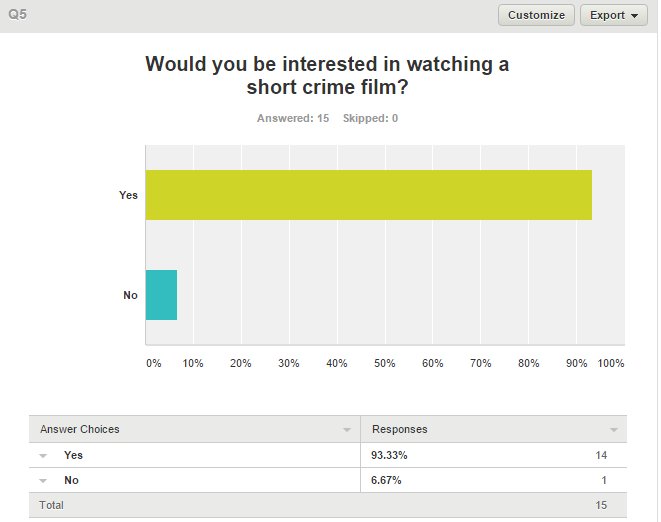
Having asked if they liked the genre. question 5 was designed to ascertain whether they would actually watch a short crime film as opposed to a feature film. The response was extremely positive with 93.33% saying they would and only one person saying they wouldn't. Again this high amount of "yes" answers may be due to the high amount of these responses coming from media students who usually like films. However this still suggests that those who are passionate about films are fond of the crime genre, even if this doesn't represent the average person.

Similar to question five this asks if the participants would attend a screening of the short. This got the same results presumably from the same people reinforcing the previous results.

Question 7 was very important when considering the characters and the diagesis of the film. The results were quite evenly spread, however a comic crime film was clearly the stand out favourite and this was pleasing to me as this was the type I wanted to make. The second favourite was a biographical crime film. To make a short biographical film would be very hard with the resources I posses as well as the issue of trying to tell an detailed and cohesive story of someone's live within ten minutes, I decided early on I didn't want to make a biographical short crime film. In regards to the nationality both British and American received equal amounts of votes. Looking back I believe it would have been more beneficial to have these to as a separate question as to have a more reliable result. However I have decided to make the characters British as upon filming I believe it will be easier to film in our own accents instead of adopting slightly on sounding American ones.
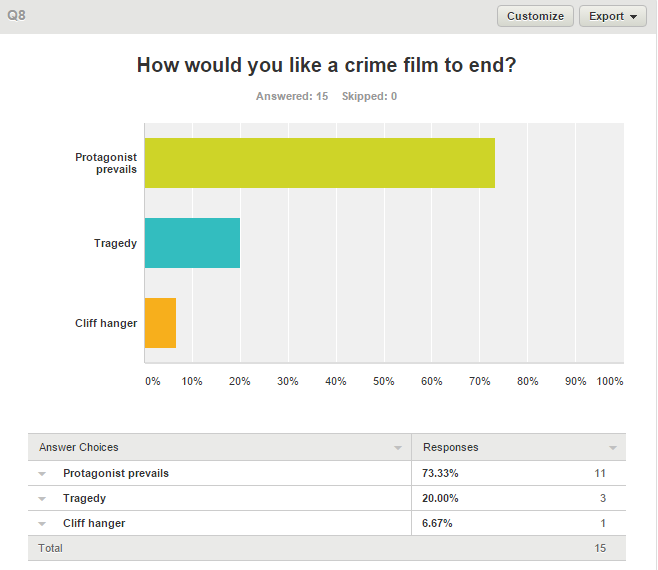
The last question asked what sort of ending the participants like to see in a crime film. The overwhelming answer was one in which the protagonist prevails conquering what ever story line throws at him with 73.33% saying they favored this ending. The second most popular and also my favored ending is that of a tragedy with 20% saying they would prefer this ending. I believe this is the ending I will go for despite the results. This is due to the fact that I want to create a comic crime screenplay, and although I want the characters to be likable, I don't want to insert a super hero subtext or narrative in to the screen play. I want the characters to be believable and therefore not a black and white story of a good natured but flawed character prevailing against the purely evil villain as I think this is a warn out cliché.
Taking in to consideration my influences for my ten minute short, that being Guy Ritchie films like Snatch (2000), Lock Stock and Two Smoking Barrels (1998) and probably the most influential RocknRolla (2008). Because of this I researched the types of demographics and psycho graphics that like those sorts of films aim to entice. Most of Guy Ritchie's gangster films follow working class, male criminals in an attempt to make a massive amount of money. We can therefore assume the main target audience would naturally be males from a similar working class background. Due to the working class backgrounds and professions of the characters there are many profanities used as well as dark humor, often involving graphic deaths. Because these things feature we can assume the target audiences wouldn't be below that of 15 year olds due to age ratings on films. Taking all of this into account we can firmly say my short film's primary audience will be a similar one; consisting of working class males from an age group ranging from 15-50 year olds. This would place the Primary audience in the E-C2 sections of the demographic char seen below.

When looking at the target audience from a psychographic point of view I looked to the chart seen below. I Believe the target audience would be predominantly made up of the Struggler and mainstream categories. In regards to the struggler category the description of mainly physical and mechanical jobs matches the working class demographic I have mentioned previously, and therefore I believe they will most affiliate themselves with the film. I also believe main-streamers will make up a large portion of the audience due to the fact that films are part of popular culture, as well as the fact this film will contain comedy, again something that appeals to the masses.

In summary my research gave mostly positive results finding that the majority would be interested in an already popular genre of film. I also feel the amount of responses could have been better to give a more accurate representation of the majorities attitude however a clear pattern still emerged with most of the questions allowing me to gain a definitive answer for them,and that over all the concept was plausible one and likely to be successful.
Location.

 When considering the location of the film I knew I needed to feature an area that was secluded, somewhere that the audience would believe a criminal deal would take place. The place I immediately thought of Fritton woods. Having been there many times I am familiar with the area and believe it would offer some great shots for the short. Here are some examples of locations that could possibly be used in the short. Specifically the opening seen when see the two protagonists entering the forest, and the opening in which the deal takes place.
Wednesday, 14 October 2015
Subscribe to:
Posts (Atom)