Showing posts with label C. TV Advertisements. Show all posts

Saturday, 14 February 2015

Editing history and clip analysis

Film editing is the process of working with raw footage and selecting shots merging them into sequences creating a coherent finished motion picture. The term film editing originated from the conventional procedure of physically working with film, but in recent times has also come to include the method of digital editing. In regards to film editing, originally all edits would be performed with a copy of the film negative, also known as a work print or a cutting copy. This required cutting and then pasting individual parts of film together using a machine called a "splicer". The film would then be threaded through a machine such as a Moviola seen here. Once the work print had been cut and edited fully, it would then be used to make something called an edit decision list. This would be used to help edit the original negative, splitting the shots into rolls, which would then be contact printed producing the final film print. In modern times many films are now edited digitally on software like Premier Pro, discarding the use of work prints and splicing film together. Instead the film can be optically scanned into a computer, and a cut list will be made by an editor, this method is called digital intermediate. Another method that negates the need for the splicing of film, and therefore saves valuable time, is in camera editing. This is the technique of shooting sequences in a strict order, resulting in the edit already being complete when the film is developed. Because this technique saves a lot of time as well as film its self, it also keeps costs down.
There are many differences between digital film making and using actual film. Originally when when digital filming became an option, the picture is gave was no where near as good as that of film which for years meant that film dominated despite its high cost.  However as digital camera technology advanced the resolution and clarity of the picture has come to meet the level of film allowing for its other benefits to be taken into account. By far the biggest advantage of filming digitally is the ability to see what you have recorded straight away, where as shooting on film requires sending the film off for it to be developed and then a day later you are able to see what you have captured, and if what you have captured isn't good enough, you would then have to re shoot requiring more time, more resources and therefore more money. However with digital film making you could have the footage with the editor on the same day, happy with the knowledge that you like what you have recorded. Another advantage that digital has over film is the amount of time you are able to record. With film cameras you are able to record for about ten minutes before having to load another roll of film into the camera. While with film you are able to shoot, re-shoot and keep doing so without the concern of a time limit. This has however also been seen as a disadvantage, with some actors and film makers saying they prefer the traditional method of filming for ten minutes then breaking as it helps them perform better. There are however other advantages to film making than just being traditional. Film offers a shallower depth of field. This means it is easier to create areas in the frame that are soft focus or blurry to direct the audiences attention. Digital films main advantages are work flow, price and reproducibility. Filming digitally speeds things, as said before with film before shooting a film magazine has to be loaded in a light safe area. After shooting is done the film has to be sent of to be developed and processed and in recent times digitalized so it can be edited on software like Premier pro. Where as if you shoot on video (digitally) you can skip these steps. You record straight onto an SD card and can watch the footage you have recorded seconds after capturing it. Price is another up side. Shooting film is incredibly expensive, a four hundred foot roll of 16mm film costs about $100 and can film for around eleven minutes. However feature films are shot on 35mm and cost around double the price, meaning you are paying around $200 for every eleven minutes you shoot. Where as in digital film making the media is usually stored on SD cards which can be used over and over again. Reproducibility is also an advantage for digital filming, video can be copied over and over again inexpensively with out any loss of quality unlike film. The other main difference between film and video are the ways in which transitions are made. With actual film editing performing a cut requires cutting bits of film and taping two ends together two produce the necessary sequence. A fade would require placing one frame over another giving the effect of one frame fading out and the other fading in. With digital editing however these transition would be performed by software included in editing programmes.

Clip analysis
As filming has evolved since its birth different techniques have evolved with it. These techniques are rarely noticed while watching a motion picture, but have a staggering difference in how the audience perceives a film. To demonstrate these techniques I have chosen a clip from the film The Departed (2006, Martin Scorsese). One of these techniques or systems that has developed is the continuity system. This aids the audience in understanding the relationship between each shot, creating an orderly flow allowing the audience to follow the action without being aware of the careful construction it has required. Many techniques create the continuity system and one of these is the establishing shot. This is a shot that establishes the setting of a sequence giving the audience context and information of the location, time of day and the characters involved and will usually take place at the beginning of a scene as it does in my clip at 0.00 as seen here.
This shot is a stationary establishing shot giving us the location of the. Soon after this the shot switches from an establishing shot to a tracking shot, as the camera physically moves following Matt Damon's character into a building before cutting at 0:08.
The clip also has another type of moving establishing shot starting at 0:08. The movement is called a crab shot as the camera physically moves from one side to the other without any change of angle. This shot is also an establishing shot at it makes the audience aware that the action is now taking place in a new location, in this case the roof top of the building Damon's character has walked into in the previous shot. The camera becomes stationary at 0:15 and then cuts to the next shot at 0:18.
Another important rule that maintains the audience is unaware of any construction and that they stay immersed is the 180 degree rule. In film making the 180 degree rule refers to the on screen spatial relationship of characters or objects within a scene. A make-believe line called the axis links the characters or objects and by keeping the camera or cameras on one side of this axis for every shot of a scene, characters in the scene will always appear on the same side of the screen. This helps maintain the context of the scene as the audience will not get confused as to each character location, maintaining continuity. This technique can be seen being used in this clip at 1:24 

Here we can see the camera never crosses over the 180 degree axis and the characters position in relation to each other stay the same. There is also another technique that falls under the continuity editing label called shot reverse shot. This is a technique where one character is filmed looking at another character off of screen at which point the shot cuts to the next which shows the other character looking at the first who is now off of screen. Since both character are shown looking in opposite directions, the audience assumes they are facing each other. It also de-emphasises the transitions between shots so the audience perceives a continuous action which plays out linearly, in order and in a logical way. It is also an example of an eye line match. The 180 degree rule however is sometimes broken for specific reasons. A camera passing over the 180 degree axis is called jumping the line. This occurs in my clip. At 0:19 we see a crab/tracking shot with Leonardo Dicaprio's character on the right and Damon's on the left.

This shot cuts at 0:30 when Dicaprio's character hits Damon. The camera is still within the 180 degree axis however but it is enough to give the illusion that contact was actually made.
This shot ends at 0:31 and cuts to the next shot which does slightly break the 180 degree rule as seen here.

As seen here the camera has just crossed the axis however this is for a reason. The sequence that is made up of those three shots is a match on action and breaking the 180 degree rule was uses to perform it. A match on action shot is simply a shot that portrays the action of the previous shot from a different perspective. In this case the action was the punch performed by Dicaprio on Damon. Matching on action gives the impression of continuous time when watching the edited film. Having the character begin an action in one shot and carry it through to the next shot creates something called a visual bridge. This in turn distracts the viewer from noticing the cut and from noticing any continuity errors between the shots. The last technique falling under that of continuity is motivated editing. This is a method that motivates what the audience see or hear. An example is an eye line match cut like the shot reverse shot mentioned before that takes place at 1:27 through to 2:14.

Making sure the audience identifies with the main characters in a movie is vital because it keeps them immersed and involved with the film. There are four main techniques used to do this. The first is screen time. This purely refers to how much time a character or object has on screen and therefore how much time they are exposed to the audience. In my clip the characters that are on screen the most are the main protagonist of the film being Leonardo Dicaprio and the main antagonist Matt Damon. Obviously the more screen time a character has the more time the audience has to identify, relate and get to know that character, and therefore there is a higher chance of audience members becoming emotionally invested in said characters. Close ups are another method that aid the audience's identification with a character as enables an audiences to see emotions. An example of a close up can be seen here at 1:02 as well as 2:38.
As seen here we can see very clearly the emotions that our characters are displaying, and therefore on an emotionally level we as the audience relate to them more then say a character we see from distances like medium and long shots. Point of view shots also help us connect with main character as it puts us in there shoes there are two point of view shots that take place just before the climax of the seen as Damon's character is handcuffed in the elevator at 2:51 which cuts also at 2:51 to a point of view shot of the elevator floor tracker seen here.


The last technique is called a reaction shot. This is a shot that cuts away from the main action of a scene to display a character reaction. In this clip there is not a transition that shows a reaction but a continuation of a shot where the action leaves the shot, and the character is left to react. This however still serves the same purpose switching focus from the action to that of the reaction of the character.At 3:10 the clip cuts to a close up of the out side of some elevator doors that then slide open acting as a wipe using part of the diegesis of the film seen here.

The main protagonist is then suddenly shot an killed instantly. The death isn't emphasised much, it simply happens in one shot. Because of the lack of build up to the death as well as the lack of focus on it afterwards it almost has a harder impact on the audience whose faces probably look similar to that of Damon's reaction after it occurs seen here at 3:10 to 3:15.

I think Martin Scorsese chose to keep the shot running instead of cutting to a shot of Damon's reaction because the continuation of the shot had more impact on the audience, like in real life, after the main characters death, life or in this case the film just goes on.

Also important in sequence are pace, tension and suspense. These effects are brought about through a number of different methods. Shot variation is one of those methods. This simply refers to using different types of shots, such as medium, close, establishing, high and low elevation and many more. From 0:00 to 0:08 we see first an establishing shot that turns into a tracking shot, this gives context and then follows the action giving context to the sequence. Next from 0:09 to 0:15 we have an establishing crab shot, the crab shot shows gives the audience a more detailed view of the setting as it reveals more to them, in this case it also builds suspense as once the camera becomes stationary it reveals Dicaprio lying in wait for Damon. The music at this point also fades out enabling the audience to listen intently to the upcoming dialogue that is about to take place. A different technique is a montage used to condense space, time and information. There isn't one is this clip however there is one in a different clip in the film seen here. This clip is also an example of parallel editing and crosscutting, cutting to different characters perspectives over the same time period. The montage starts at 0:56.

Providing an withholding information is another way of manipulating the audience's feelings. The scenes before and after Dicaprio is shot come to mind. As they are going down in the elevator we as an audience are unaware that another character is lying in wait to kill Dicaprio. So when the elevator doors open up and he is suddenly killed we are unaware who has actually kills him until the camera at 3:17 begins to pan upwards from a low elevation shot to reveal his killer a shown here at 3:20 

Another method is cross cutting. This is method that shows different shots at different location taking place at the same time. Cross cutting can add suspense to a film as the simultaneous action can have consequences that affect each other, as well as giving different perspectives on situations. The film American Gangster (2007, Ridley Scott) uses cross cutting to showcase the different character perspectives of the heroin trade in 1970's New York that can be seen at this link: http://movies.wikia.com/wiki/File:American_Gangster_-_Thanksgiving
Editing rhythm is another important way of dictating an audience's mood. Usually if there is a lot of action taking place there will be fast cuts. However in the most action packed sequence in the clip there are longer shots than you would expect to find. For example the shot in which Dicaprio is shot lasts from 3:10 to 3:15. The next shot involves a stationary low elevation shot of Dicaprio lying dead on the floor which then seen the camera slowly pan up. Again these transitions and camera movements don't match what's happening in the sequence. I however think this works because of that very reason, because there are no fast cuts or camera movements we as the audience are left to see everything fold out. I feel this method actually hits the audience harder because of the lack of editing. 
The way in which the story is constructed, relating to the time and space of the story including what is in the diegesis of the film, and what is implied.Basically these are techniques used to condense the time and space of a story, thus to keep the audience interested and entertained, without actually depicting everything that has taken place in the story.  An example of this can be seen at 0:06 where Damon character opens the door of a building. The shot then cuts to a crab shot of the roof of the building slowly revealing DiCaprio's character hiding, waiting for Damon's character who appears at 0:15. Now obviously in real life it would take far longer than 9 seconds to get from the bottom to the top floor of a building. However in the interest of time and entertainment the shots are constructed in way that condense the time and space of the story, while maintaining context. Simply said we as the audience know he has travelled up through the building, without actually having seem him do so. This technique can also be performed through the use of implying the occurrence of certain events that take place within the time and space of the story, but to not feature in the diegesis of the film. An example of this can be found at 1:45 where DiCaprio say "I got boxes of tapes, evidence other documents proving it". This implies that at some point, he has gathered all of this evidence, however this doesn't feature in the actual film.
Cutting to soundtrack in the method of timing cut transitions to match the music. An example of this can be found in the shipping to Boston video above. At 0:56 the sound level rises as we cut to another shot which is also the begging of a short montage. At 1:03 we have another cut that is timed with dialogue in the song. The effect this has is that it becomes more striking to the audience and helps translate the feeling of the scene to the audience. For example this film is set in Boston and the music used in this clip has hints of Irish music  which link well with the city of Boston's Irish heritage.
Using multiple points of view is another way of helping the audience focus on the action and on what the director wants them to. As suggested by the name of this technique, the method entails using multiple camera angles to display the same bit of action, thus giving the audience a greater perspective of the action, and engaging them more in the film. The film Life Of An American Fireman (1903, George S. Fleming, Edwin S. Porter) shows this technique being used at the very early stages of film making. It depicts the event of a fireman saving a women from a burning building; the audience first see the event from inside the building as fireman pick up the women and take her outside to safety. We then see the same action from outside the building. The use of these two views gives the audience more perspective on the action they have just seen and context in relation to the time and space of the film world. This technique now found in almost every modern film, especially action films has developed far past that of which is seen above. The technique is commonly used in fight scenes because of their fast nature. Using multiple view points in a fight seen allows the director to maintain the exciting pace of the fight, while still allowing the audience to follow who is who and what is happening. We can see an example of this from a clip of The Bourne Ultimatum (2007, Paul Greengrass) in which a fight takes place using multiple points of view allowing the movements and actions of the main character to be followed by the audience. Using quick cuts between these multiple points of view also has the added positive of making the film exciting. The fight scene starts at 2:15 ending at 2:43. We also see a shot in between the fight at 2:30; an over the shoulder of a character Matt Damon's character is protecting. This shot again is used to make the audience aware of the time and space of the characters in relation to each other, this is another prime reason multiple points of view are used. We also see a great example of cross cutting/parallel editing at around 1:45 in which we cut back and forth from seeing the action from Damon's point of view to the view point of some character tracking the action through cameras at a different place in the diegesis of the film.
   
A cutaway is another editing technique. This is the method of interrupting a shot of continuous action by cutting to another shot depicting something else. This is then usually followed by a cut back to the original shot. The shot that is "cutaway" to doesn't give any necessary or extra action to the scene, however allows for a longer sequence. It also allows for a change of pace in the main action of the film as well as allows for any unwanted parts of the film to be covered by the cutaway. The cutaway will usually depict something that is in the same location as the main action as it allows for this cut back. An example of a cut away can be seen here in this clip from The Godfather (1972, Francis Ford Coppola) at 2:15.

Jump cuts are another editing technique that it occasionally used although not as often as some of the others. This is because the method is considered a violation classical continuity editing. A jump cut is simply a cut between two sequential of the same subject where the camera is in a slightly different positions. This edit gives the effect of jumping forward in time. Because editing is by the majority considered to unnoticeable and constructed in a way that makes the film seamless, the jump cut technique is rarely used in mainstream films. The technique however is commonly found on you tube vlogs. Because these vlogs don't have stories or a narrative the use of jump cuts and lack of fluidity brought about by a jump cut doesn't negatively effect the content. An example of a jump cut beingused in a film can be seen here.


Monday, 2 February 2015

Technical side of editing.

1. What to the numbers 16:9 refer to?
This refers to the aspect ration of a Television. The aspect ration is the width in relation to height of a video. 16:9 is the aspect ratio found in newer TV's and are HDTV's often wide screens.

2. What is the frame size of a 1080p video?
1920x1080 pixels.

3.If you have a video file which is 720:50p what is the frame rate and what does the p stand for?
The first number refers to the video size, while the second number refers to the number of frames per secon, so in this case the frame rate would be 50fps. The p stand for "progressive scan" and shows each frame one after the other.

4. What is the difference between p and i?
 p an i are both different methods of showing the frames, P or progressive scan, shows frames one after the other, while i, interlaced, interlaces half a frame at anyone time, and interlaces these half frames together to show unified movement. P is far superior to i however produces much larger files.

5. What frame rate is real film shot at?
24fps

6.What might be the advantage of shooting at a higher frame rate?
The higher the frame rate is the smoother movement will appear, this means fast action will be clearer shooting at a high frame rate, while shooting at a lower one may cause fast movement to look blurry.

7. What defines a lossy file?
A lossy file is a file type used to store video and sound. Lossy files are highly compressed files that are compressed to reduce file sizes. As the name suggests Lossy files to sacrifice some detail.

8. Name 3 file types commonly used in video editing.
AVCHD is a domestic camcorder file type. It is highly compressed and often has the suffix .mts.
MOV is a video file type associated with Apple Quicktime. It has the suffix .mov and is also compressed.
FLV and F4V are flash video files. Flash is used on the web, these files can be described as lossy as they to are compressed.

9. What is the difference between a video file type and a codec?
A video file type is the format in which the information is stored, where as a codec refers to how the file type is compressed.

10. What is a bit rate?
Bit rate is the rate in which a file processes information. The higher the bit rate of a file, the more powerful the computer being used needs to be.


Editing process


TV Advert evaluation

TV advert evaluation.


In our brief for the Advertisement Production for Television unit we were given the grading criteria and were tasked to “produce a TV advertisement to a good standard showing some imagination” and also to produce a product that “reflects near-professional standards, showing creativity and flair and working independently to professional expectations." We had to re-market an already existing Unilever product, aiming it at a new target audience. My group chose the men’s aftershave Brut aiming it and teenagers and young men and more particularly students. We each made presentations using Prezi, displaying and explaining the ins and outs of our idea, and how we planned to appeal to our target audience. In the end our group decided to re-market Brut because we thought the idea would be more successful than proposals that had been put forward. Previously Brut was aimed at older men with Henry cooper featuring in previous commercials, as well as Kevin Kegan also featuring as seen here. As said previously we decided to try and appeal to younger men and students because we felt this would be a natural transition for the company in real life, as well as being students ourselves, which made it easier to create a product that appealed to our target audience.
To gain feedback we first played our finished product to the rest of the class, who happened to fit into our target audience. After watching the advert everyone gave us feedback, specifically 3 things they liked about the advert and 2 things they felt could be improved. For the most part people liked the advert saying it hit the target audience very well and was extremely funny. A recurring suggested improvement was some of the sound in the advert was hard to understand, referring specifically to sections of slow-motion used that made the speech slightly ambiguous and hard to understand. We also created a survey using the website survey monkey. This allowed us to design specifically tailored questionnaire that would provide us with the information we required as well as creating graphs displaying the information automatically in a concise fashion as seen below. The questionnaire contained 10 questions:
1. What didn't you like bout the advert?
2. Who do you think that advert is aimed at?
3. What is the advert selling?
4. Do you think the advert would be successful?
5. Would you buy the product?
6. What improvements would you make to the advert?
7. What time of day would you expect to see this advert on TV?
8. What channel would you expect to see this advert on?
9. What did you think of the advert?
13 people responded to my questionnaire in total giving a range of answers. When it came to the first question, the resounding feeling was that people felt the sound was their least favourite part about the advert, this wasn't surprising as when showed to the class this was also the conclusion.
 Question two also gave a clear answer with 76.92% agreeing the advert was aimed at the 16-21 age group with the rest of the answers saying the 22-30 group. This was pleasing as we felt the responses indicated we successfully hit our target audience.
Question three, although seeming very obvious, was also reassuring as the responses showed the audience were able to identify the product correctly, with 100% of answers saying the product was Brut, which is obviously vital.
Question four also gave us pleasing results as 69.23% said they thought the advert would be successful in re branding the product, with the other answers saying it needed a little work in some areas and no one saying they believed it was a total failure.
Question five asked whether they would buy the product. Here the answers were mixed with 46.15% saying they would buy it, 38.46% saying the might buy it and 15.38 saying they wouldn't. This overall was still quite satisfying, with many of the answers coming from girls, who aren't in the target audience which will account for some of the no answers.
The sixth question asked what improvements they thought should be made to the advert, this also had a clear answer with 100% of people who answered saying the sound needed improving, as well as someone answering both sound and editing. Again I believe this to be due to certain slow motion sections of the advert which may need speeding up to allow the audio to become cohesive.
The 7th question asked the audience what time of day they would expect to see the advert on television. 75% of those who answered said they expected to see the advert on in between the times of 9pm and 12am while the other 25% said they thought it would be on between 5pm and 8pm. This was as expected as it was the time range we aiming for. This is because these time ranges are appropriate for us to gain as much exposure to our target audience as possible.
The 8th question asked what channel they would expect to see the advert on, 53.85% said they would expect to see it on channel 4 and 46.15 percent being given to both ITV and ITV2 because of people picking multiple options.  This suggests that people think the advert related to a younger demographic as do channel 4 and ITV2.
 The last question asked what they thought of the advert in general. 38.46 percent rated the advert as excellent with the remaining 61.54 saying it was good.
In regards to appropriateness to the audience I believe we succeeded in appealing to our target audience. Both the results from the questionnaire and the feedback we gathered from our peers suggested the audience was able to identify that we were targeting students in between the ages of 16 and 21. I feel placing the advert on a college helped to associate the product with students allowing them to identify the product is for them. We also included language found in the sociolect used by students of this age such as “viscous par” which will also relate to our target audience therefore making the product by association seem more appealing to them. There was also a heavy use of humour implemented in the advert as this acts as a convergence device making the product more attractive to the demographic we were targeting.
The mise-en-scene of the advert for the most part worked well. The setting of the advert was a college and therefore filming in a real college meant we didn't have to manipulate our surroundings too much if at all to create a setting that was believable. There were three locations/ settings in the advert, a classroom, corridor and courtyard. The only setting we had to change slightly was the classroom, including moving some tables around and changing the position of some seats. The main thing that stood out to me as being lacking was the amount of extras. Some of the shots could have been made to look more convincing had there been one or two more people in the background. This didn't hurt the advert too much but would have made it seem more professional.
The camera work was mostly done with free hand due to the fact many shots involved following the character whilst moving and because other shots required being in position that wouldn't allow for the use of a tripod. However this didn't negatively affect the shots that were still as very little movement can be detected in them. Something I liked about our camera work was the variety of shots we used. We have long, medium and close up shots as well as establishing shots that give context to the spacial relationship between characters and different angles in the advert that give it a nice flow as well as giving context to the positions of character well. This enables the audience to follow what is going on, and therefore translating the message of the advert well. There is one shot we used that slightly breaks the 180 degree rule. This shot however doesn't confuse the viewer and also allowed for a nice shot that shows the boy walking past out of shot
, and then cuts showing the girl following him with a new found interest because of the product.
We also have another shot we used at the end. This is a close up of the Brute bottle on a bench that is then thumped with thumbs up. This ended the advert nicely as it shows a close up of the product leaving it fresh in the viewer’s minds.


The editing I feel for the most part also worked well which was also reflected in our results with only one out of the thirteen participants saying they though it needed improving
. We used many short shots and cuts to transition from each one as this grabs the audience’s attention, and also matches the over the top style of the advert that appeals to our target audience. The cuts I feel also flowed well making it easy to watch. Another part of editing that I think worked well was the implementation of screen bars half way through the advert once the character uses the product. The association the screen bars and “cool” Hollywood films helped to convey the message that Brut makes you “cool” and made the transition from the un-confident character we see at the beginning to the very confident character we see using Brut visible and more evident. We did have a slight mishap that was noticed after publication however in which all except one of the shots contains the screen bars;
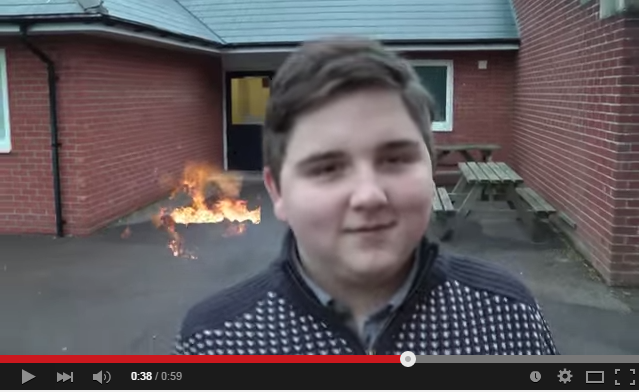
this is something that could be rectified to polish the advert off. We also used some special effects in the advert in the shape of an explosion that appears when the character throws the Brut bottle arrogantly over his shoulder. This was very over the top however suited the rest of the advert. A feature that worked well in some areas but not others was the use of slow motion. The feedback we got from our peers was mixed as in some cases the slow motion made the narration unclear, and said some words were hard to recognize which reflected in the questionnaire results as well
. I personally liked the use of the slow motion for the humorous and again over dramatic feel it gave the advert. An improvement that could be made is to scale down the severity of the slow motion as to still maintain the humour gained by using it, but also allowing the audio to become clearer and easily understandable.
As for sound we used music created by a class mate. To begin with we use a piano piece that is quite sad and low tempo to convey the characters feeling of rejection. In correspondence with this we used a voice over that narrated and commented on the characters actions and surroundings. The voice used its self was very strange, and was said to be alike the voice of “Cartman” a character from the series “South Park”. This voice almost directly talks to the target audience, asking rhetorical questions that may help the audience relate more to the advert, as well as being funny. Half way through the advert when the character uses the product we switch from the sad background music to a more upbeat rock style song that conveys the new found confidence gained because of the Brut. This again translates the message that Brut makes you more confident and in turn more successful. As for the rest of the voice over, we used lines such as “It puts the B in burly” and “the r in rawww”. This again was very over the top, which emphasized the point being made, while not taking ourselves too seriously and being self aware, which I think would appeal to students.
 Our feedback told us that we had successfully advertised the product to our target audience. In relation to story line and narrative, our advert is very simple. Basically we are saying without Brut you are un-confident and will never be noticed, but with it you’ll acquire all the confidence you need to become attractive and will be noticed. In the advert we show two encounters between the girl and the boy in which the boy is totally ignored and rejected, because he isn’t wearing the Brut. The third and last encounter is where we show the transition Brut supposedly gives you, and the boy successfully gains the attention of the girl. The basic selling point here is sex appeal and the possibility of successful romance, with the connotation of success in everyday life. I think this would work well for our target audience with companies such as Lynx who target a similar audience use the same selling points.
The message we were trying to send was that Brut is now aimed for at the younger male, and more specifically students. We did this by placing the advert inside a college and the characters were students. This immediately would strike a chord with our target audience identifying that the product is intended for them. We used demotic language that the age group use which also associates out target audience with the product, while the narrative was really an emphasized version of a situation many of our target audience could relate to. All this would hopefully make the product appeal to them.
The overall quality of the advert I believe is quite high this was also reflected in our results
. I think the range of shots as well as the fluidity makes it easy to understand and allows for the message to be received clearly. The main thing I would change to increase its professionalism would be the sound specifically the clarity of some points of the narration. The change would be made by speeding up the footage that has been slowed down. This would result in the words being said becoming easier to understand improving the advert. In regards to whether the advert would meet ASA and Offcom regulations, i believe there may be one problem. There is a section of the advert were the narrator pronounces the first part of the word “bitch” but is cut of as the advert cuts to another shot, not completing the word, but still having the connotation. An ASA BCAP code that may affect this part of the advert is 4.1:
 “Marketing communications must not contain anything that is likely to cause serious or widespread offence. Particular care must be taken to avoid causing offence on the grounds of race, religion, gender, sexual orientation, disability or age. Compliance will be judged on the context, medium, audience, product and prevailing standards.

Marketing communications may be distasteful without necessarily breaching this rule.  Marketers are urged to consider public sensitivities before using potentially offensive material.

The fact that a product is offensive to some people is not grounds for finding a marketing communication in breach of the Code.” 
Because the connotation of the word is there, and the narrator is talking about a female character, this could cause offence even if the intention was humour, meaning it may have to be removed before it could be seen on television. It may also break the Offcom rule of swearing on TV before 9pm. This could lead to complications although our intended time to run the advert was between the hours of 9am and 12am, it may remove any other options we have. Some of our results also suggest other people thought it may be offensive to with two people saying they thought it wasn't suitable

In summary I am quite pleased with the advert overall and we stuck to the original idea we had. There were some shot changes and some added effects such as the explosion and slow motion used that were thought of after pre production. This however is a natural part of creating moving image media and didn’t affect or alter the premise of the idea we were selling. In regards to the feedback received I am also very happy. The overall feel was that people enjoyed the advert and felt it reached its target audience very well. Some parts of dialogue need to be made more concise so everyone is able to understand what is being said, but apart from that and making sure we comply with all ASA and Offcom regulations, the advert was received very well. When it comes to my personal involvement in the production I feel I definitely pulled my weight. I took charge of most of the pre production work, creating the shot list and co-writing the script as well as gathering the required permissions and filling out the risk assessment form. When it came to the actual filming of the advert I directed and filmed it. For the editing I also did a considerable amount. Once I had cut and ordered all of the footage so it ran smoothly, matching up the audio including a soundtrack and dialogue took quite a bit of time. Once we had the overall structure of the advert, I began to experiment using key frames and slow motion, which for the most part I feel positively affected the advert, apart from some parts of audio that were made unclear as a result. Overall I am happy with my involvement in the production and feel I had a positive impact in the group.