Showing posts with label H. Single camera unit. Show all posts
Showing posts with label H. Single camera unit. Show all posts
Tuesday, 17 May 2016
Short film pre production paper work
The script.
Pre-production paper work - Part 1:
Pre-production paper work - Part 2
<

Friday, 29 April 2016
Single camera techniques.
In this essay I will define and explain what is meant by single camera technique, describing what exactly is involved when using the technique, covering all the different aspects involved including the camera, lighting, sound and editing. This technique is used in both TV and film and is probably the dominant method of film production. Films such as Drive (2011, Nicholas Winding Refn) and TV shows like Scrubs are two examples of media texts that utilised the technique both of which were very successful.
A single camera technique is the method filming using one camera to capture all the different angles and shots of a scene and film independently with one camera. This involves moving the camera to the different positions required and re-shooting the same scene multiple times and then in post production editing the different shots to create a coherent scene. As mentioned single camera techniques require the movement of the camera, usually the director will do this by first pointing the camera in one direction and letting the whole or at least a substantial part of the scene play out. He then sets up the next position and continue this process until he feels he has all the shots he needs. Between the shots the lighting will be changed to make sure everything is lit in a way the director likes. In post production the scene will then be constructed using all if the shots to make the scene.
The single camera technique offers directors much more control over a scene, however is far more time consuming and expensive than that of the multi camera technique which uses multiple cameras in relatively fixed positions. The multi camera technique is almost exclusively used in TV rather than that of film.
Below are stills from The Departed (2006, Martin Scorsese) Which shows the nature of the single camera technique as we see a conversation between two people that uses reverse shots. If multi camera had been used we would be able to see the cameras in each respective shot, however we don't.
A single camera technique is the method filming using one camera to capture all the different angles and shots of a scene and film independently with one camera. This involves moving the camera to the different positions required and re-shooting the same scene multiple times and then in post production editing the different shots to create a coherent scene. As mentioned single camera techniques require the movement of the camera, usually the director will do this by first pointing the camera in one direction and letting the whole or at least a substantial part of the scene play out. He then sets up the next position and continue this process until he feels he has all the shots he needs. Between the shots the lighting will be changed to make sure everything is lit in a way the director likes. In post production the scene will then be constructed using all if the shots to make the scene.
The single camera technique offers directors much more control over a scene, however is far more time consuming and expensive than that of the multi camera technique which uses multiple cameras in relatively fixed positions. The multi camera technique is almost exclusively used in TV rather than that of film.
Below are stills from The Departed (2006, Martin Scorsese) Which shows the nature of the single camera technique as we see a conversation between two people that uses reverse shots. If multi camera had been used we would be able to see the cameras in each respective shot, however we don't.
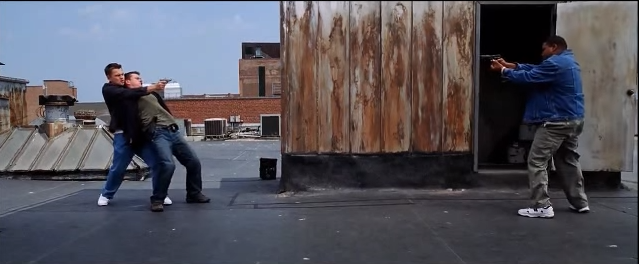 |
| This is the master shot that shows us the position of the character in relation to one another, this helps us as the audience know where character who are off screen are. |
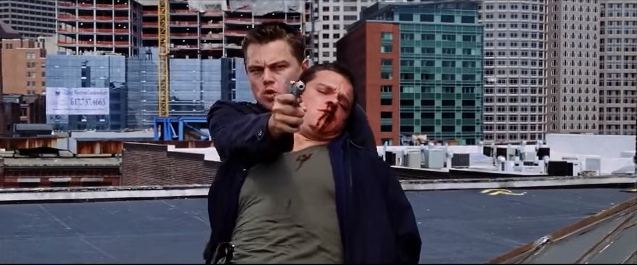 |
| Here we see the camera faces Leo excluding the other character. Notice that there isn't a camera behind Leo as this is important when considering the next shot. |
 |
| Now we see the other character, the camera is clearly positioned behind Leo and yet we do not see it when Leo is in shot. The same can be said for this character as there is no camera behind him filming Leo.
We can then see how this contrasts to the multi camera technique when looking at a show like Friends. Friends uses the multi camera technique in particular as it is a sitcom filmed live in front of a an audience.

As we see the scene much like in The departed is set up with a master shot

Here we see a different shot capturing a different angle that would have been shot on another camera. This allows for all angles to be captured in 1 take rather than filming several takes with one camera.

Again we have another angle from the same scene again displaying the differences between single and multi camera techniques
Here we can see a picture showing the different layouts and set ups of both multi and single camera techniques.
 
Lighting
Lighting has an extremely vital part of cinema having the ability to completely change the atmosphere of a scene. It is particularly important in single camera productions especially feature films. It also gives creators more control of individual shots as each shot can be lit separately unlike that of multi camera productions which use a set lighting for the duration of a whole scene. A technique often used on single camera productions is to light a certain area of the set for a character to walk into before saying their line. This has the effect of making the audience focus intently of the character and less of the surrounding environment. It also makes the scene more dramatic. The lighting an a single camera production is more of an arduous task as each shot needs to be lit in a specific and deliberate way to achieve the atmosphere and mood the director wants. A perfect example of a film using light to create different moods is Drive (2011, Nicholas Winding Refn)

Here we see firstly the use of a cool, cold pallet of colours that emphasise the mood of the scene and in unison with the lighting help highlight both of our characters. Firstly the the vulnerable child highlighted by white light showing us his innocence as a child. This is then contrasted by the other character dark and formidable presence. The lack of lighting on this character suggests to use his emotions of perhaps anger and also suggest to us he is perhaps dangerous. Also worth noting is that the lighting places emphasis on both of out characters. We also see the use of the characters eye movement to show the audience there emotions. The child looking down toward the floor shows us he is nervous and troubled. Where as the fix stare of the man shows his attention is completely on the child, and then he is concerned.

Here we see a much more warmer light used to show the content feeling between all character. We notice that the two adults who have a romantic attachment are lit far more than the child. This is to perhaps show the connection between the two. We also note again the eye movement again with the protagonist and the child locked in a staring contest and the mother looking contently at the protagonist. These subtle movements suggest the child's acceptance of the man, the man making an effort with the woman's son, and the woman's appreciation and affection for the man.
Sound
Sound is obviously extremely important in films with dialogue from characters often carrying the plot of the film, and ambient sound helps to immerse the audience into the world of the film. The sound in a single camera production is often recorded separately and then edited onto the captured video. In other words the actual sound recorded in a take isn't usually of a high enough quality as the microphones tend to pick up back ground noise. To combat this unwanted noise a Boom mic is usually used.

This is a microphone that can be plugged into the back of the camera being used and is specifically designed to drown out any unwanted background noise and record crisp and clear dialogue. There will usually be a second camera used in higher budget films to capture scenes with a high amount of dialogue.
As mentioned before much of the sound, especially ambient sound is added in the editing stage. Sound when using the singe camera technique is more flexible than that of the multi camera technique because there are often multiple shots of the same take which will often all include dialogue and ambient/foley sound. This enables the person editing to combine the best sound with the best video.
Compare this to that of the multi camera technique where characters are given an individual mic to capture clear audio from each individual. Often these mics are concealed in sitcoms, however in some shows the visibility of a mic doesn't affect the show as it is real, shows such as Have I Got News For You for example.
Editing
Single camera productions often capture a lot of footage with several takes of each shot often being captured. This makes the editing process a very arduous and technical task as it requires the finding and then sorting of usable footage and footage that isn't to be used. Often with a single camera production there will be a certain amount of overlay captured in order to make sure a shot is captured and that there is enough footage either side of the intended capture footage to edit with. Both these reasons often result in single camera editing taking longer than that of multi camera productions.
Contrast this with that of a multi camera production which can sometimes depending on the production be edited live, take a football match for example, although not a conventional set up it is still using the multi camera technique. An example of a single camera film that uses this technique would be Kiss Kiss Bang Bang (2005, Shane Black). The fast paced cuts we see in this film lend them selves to the single camera technique as they tell stories from multiple perspectives, not just the audiences.

Genres and formats
Obviously single camera and multi camera formats tend to be used on different formats as each have their disadvantages and advantages. For example feature films almost never use the multi camera set up because it doesn't provide enough adaptability or variety of shots that a needed to tell an in depth story. However the single camera technique does offer both of these things and so we see this technique used exclusively with in feature films such as Drive (2011, Nicolas Winding Refn).
 
The multi camera technique lends it's self to the serial format, this refers to shows such as Eastenders where the characters are the same and the story develops throughout the multiple episodes. The soap opera is a specialised form of a serial which is characterised by multistrand narrative of overlapping and equally balanced stories and the story goes on for ever. The multi camera technique lends its self to this format as it allows them to be produced quickly.
 |
Wednesday, 20 April 2016
Research on Diamond day
Themes
There are many themes surrounding the idea of Diamond Day, one of the key ones is the idea of criminal behavior, mainly aimed at this idea reflected in a gangsta's lifestyle. The MOB life, the dangers that can occur when you mess with dangerous people in the business. This can be linked to themes within the film Snatch. (2000) a Russian gangsta and two incompetent amateur robbers, the theme of defying someone with great power over society. Showing the situations that can occur when you involve yourself with people in this type of lifestyle. A theme of dark humor can be portrayed through the events that happen, it can be based on actual events that happen in day to day life.Another theme that we would like to include is the theme of friendship, in Diamond Day there are two men who seem to get themselves in a pickle, accidentally stealing from a Big Boss and not realizing what they have done, until they come face to face with the effects of their actions. They are in it together and have a clear bond when they made the same mistake, they need each other in order to achieve the task set by the boss to repay their debt. Similarly to the friendship between the main two protagonists in the film Bad Boys 2 (2003) They are placed in a difficult situation and they need each other. We would like to portray this theme and add some comical element to it because it keeps the characters down to earth and the audience can relate to a friendship they may have with a friend, even if they are not criminals.
Diamond day takes inspiration from many different gangster films, for example Snatch (2000, Guy Richie), London Boulevard (2010, William Monahan) and Kiss Kiss Bang Bang (2005, Shane Black).
First of all the short will most likely resemble Snatch and other Guy Richie films with it being British gangster comedy. Much of the humour will emulate that of Guy Richie films with it being dark and satirical. Below is the trailer for snatch.
Another Guy Richie film that I took inspiration from is RocknRolla (2008, Guy Richie). Again the film appeals to a similar demographic and also focusing on a small group of criminals trying to make it big. Like many of Guy Richie's films there is comedy through out in the form of us the audience laughing at the predicaments the protagonists get into. Such an example can be seen here from RocknRolla (2008, Guy Richie).
We also see in this clip the idea of a criminal duo, friends who work together committing crimes to make money. This was an idea I wanted to use in Diamond day, and so the idea of Graham and Paddy developed.
Another film I took inspiration from is London Boulevard (2010, William Monahan) This also tells the story of a criminal protagonist under the thumb of a criminal king pin, this was also an idea I wanted to explore, an omnipotent criminal that control our protagonists.
Here is a clip below.
Lastly Kiss Kiss Bang Bang (2005, Shane Black) which explores the idea of an amateur criminal getting entangled in the criminal underworld and more importantly with a criminal boss. This film is American and is perhaps more of a noir, however still implements the elements of humour I wanted to in Diamond Day.
Linking to Society.
 |
| http://www.nydailynews.com/new-york/nyc-crime/30-mobsters- nabbed-connection-italian-mafia-article-1.1609347 |
 |
| http://www.imdb.com/title/tt1827163/?ref_=ttmd_md_nm |
Locations
When considering the location of the film I knew I needed to feature an area that was secluded, somewhere that the audience would believe a criminal deal would take place. The place I immediately thought of Fritton woods. Having been there many times I am familiar with the area and believe it would offer some great shots for the short. Here are some examples of locations that could possibly be used in the short. Specifically the opening seen when see the two protagonists entering the forest, and the opening in which the deal takes place.
After reading the script it was evident that we needed the correct location in order to make it look cinematic and create the desired atmosphere. The location is very important for us as we need to find a place to make it look believable and also somewhere where we will be allowed to film with guns. Due to the majority of the film being shot within the woods as well we need to make sure that it is close by so we can access it easily and that will also mean that we can go backwards and forwards to allow us to have a lot of time there.
As you can see above forests look really nice due to the warm colours and shadows that are created. We will be filming this in April as well so the leaves will be nice colours and the shadows will look great on the protagonists to create that eerie, mysterious look.
As well as a forest we need a room where some of the characters will meet and have a conversation that will lead to the action that takes place later on in the film. This room needs to have a look that is once again believable and that will fit into the style of the film we are trying to create. We want to try and avoid using the college as it's an environment that is seen every day and not very aesthetically pleasing. We need a location that will fit 4 people in and where we will have time to shoot some lengthy conversations and still make it look nice. This could be done in a house with some lighting - that's our best option.
Above there is a helpful video of how we can film this dialogue and shows what we need in order to make it look good. By filming in a spacious house we are more than able to do this and will be possible.
Friday, 5 February 2016
Single and multiple camera differences, Friends and scrubs
Friends
Friends uses the multiple camera set up because it was a sitcom shot in front of a live audience. The multi camera technique allows multiple angles and shots to be captured in one take, this contrasts with the single camera technique which requires multiple takes of the same scene in order to capture different angles. However with the multi camera technique it is often the case that the cameras are in a fixed position and therefore the amount of angles you have is usually the same as the amount of cameras you have. With the friends episode the majority of the scenes shoot the apartment all facing the same direction with the audience behind them. The cameras have to be positioned this as if they were in different locations they would appear on screen.
Scrubs
Scrubs uses the single camera technique and is set in a real life hospital. The real life location means the single camera technique is more feasible than that of a multi camera one because there will be no purpose built area for cameras to be positioned. We also see due to the real life location natural lighting effects such as shadows caused by sunlight going through blinds appear on screen that we don't see with the artificially lit set friends is shot in.
Friends uses the multiple camera set up because it was a sitcom shot in front of a live audience. The multi camera technique allows multiple angles and shots to be captured in one take, this contrasts with the single camera technique which requires multiple takes of the same scene in order to capture different angles. However with the multi camera technique it is often the case that the cameras are in a fixed position and therefore the amount of angles you have is usually the same as the amount of cameras you have. With the friends episode the majority of the scenes shoot the apartment all facing the same direction with the audience behind them. The cameras have to be positioned this as if they were in different locations they would appear on screen.
Scrubs
Scrubs uses the single camera technique and is set in a real life hospital. The real life location means the single camera technique is more feasible than that of a multi camera one because there will be no purpose built area for cameras to be positioned. We also see due to the real life location natural lighting effects such as shadows caused by sunlight going through blinds appear on screen that we don't see with the artificially lit set friends is shot in.
Monday, 1 February 2016
Research texts
The beginning of this episode features a very action packed sequence in which a drive by shooting takes place.
The scene is indicative of a single camera production as numerous angles are used to cover the action and this wouldn't have been possible as the cameras would have been captured in the shot. There are often many different perspectives in a single camera production as they help to set up the scene. When it came to depicting the action the single camera technique offers the ability to zoom in on specific parts of action all taking place in the same scene.
We also see several over the shoulder reverse shots in the episode, a trait associated with the single camera technique, again depicting a scene from different perspectives to give an overall picture of the scene.
Edge of Darkness
In the opening scene we find the protagonist, a detective in a conference hall, he is in the middle of a heated discussion with a superior who is instructing the protagonist on what he should be focusing on, current unsolved cases and inquiries. However our protagonist is instead focusing on a recent election in which he feels may have been fixed involving his superior.
The scene is indicative of a single camera production as numerous angles are used to cover the action and this wouldn't have been possible as the cameras would have been captured in the shot. There are often many different perspectives in a single camera production as they help to set up the scene. When it came to depicting the action the single camera technique offers the ability to zoom in on specific parts of action all taking place in the same scene.
We also see several over the shoulder reverse shots in the episode, a trait associated with the single camera technique, again depicting a scene from different perspectives to give an overall picture of the scene.
Edge of Darkness
In the opening scene we find the protagonist, a detective in a conference hall, he is in the middle of a heated discussion with a superior who is instructing the protagonist on what he should be focusing on, current unsolved cases and inquiries. However our protagonist is instead focusing on a recent election in which he feels may have been fixed involving his superior.
Subscribe to:
Posts (Atom)